Harmless Like You packs a punch

20170102_103657

What I read

Harmless Like You by Rowan Hisayo Buchanan

What it’s about

After the death of his father, Jay travels from Connecticut to Berlin to find Yuki, his mother whom he has not seen since she left when he was a toddler. The novel alternates between the perspectives of Yuki and Jay. Yuki’s story spans her teenage years in the 1960s up to the point of her leaving in the 1980s, and Jay’s story takes place in the present.

Yuki has lived in New York since she was a child, and when her father’s job returns the family to Japan, Yuki decides to stay behind. In the subsequent years, she struggles with her identity and with her dream to become an artist.

Jay is an art dealer married to the love of his life, Mimi. But after the birth of their daughter, he begins to question his relationship with his wife and child.

This novel tells a story of the search for identity and place of belonging while connecting it to the art world. It also looks at what we inherit from each other–the pain, conflict and harm that is passed down in a family.

Why I picked it up

This is another book I read about online, but I can’t remember where (I should keep better track of this). I think it was in a “Best of 2016” list somewhere. Then I read that Becky Toyne recommended this for readers who liked Imagine Me Gone (which I loved), and that increased my desire to read Harmless Like You.

In mid-December, I was shopping for books to give as Christmas gifts, and when I saw the cover of Harmless Like You staring at me, I decided to buy myself a Christmas gift, too.

What I liked about it

It’s not surprising to learn that Buchanan is an artist herself. This is not only because of the book’s art theme (and discussion of colour), but it’s also apparent through the style of the writing. It’s as though Buchanan went in with a big brush to tackle difficult themes and an interesting plot, and then went in with a smaller brush to add in the finer details (the sentences and paragraphs are beautifully crafted).

Yuki’s sections are told in the third person, while Jay’s are in the first. Because of this, it feels like there is a bit of distance created between Yuki and the reader, but, at the same time, this third-person narration almost gives us more insight into what she’s going through.

I also really liked the examination of parenthood in this book. It was smart of Buchanan to include various types of parents, such as Yuki’s parents and Yuki’s high school friend’s single mother. But it was most interesting to read of the struggles experienced by Yuki and then Jay when they each become parents.

You’ll want to read it if…

I agree with Becky Toyne that fans of Imagine Me Gone will like this book. It’s also a great choice if you like literary fiction, art and/or stories about complications within families.

Recommended refreshments

I think the jasmine tea that Yuki drinks (and gets her boyfriend, Lou, drinking, too) suits the book quite well. But American diners also make several appearances, and I found myself craving a slice of the cherry pie that Yuki’s friend Edison often orders after their life-drawing classes. So why not have both?
The books I read in 2016

20160807_142706There are still a couple of days left in 2016, but before we leap into 2017, I want to reflect on some of the reading I’ve done this year.
Stand-out books

The longest book I read

A Little Life by Hanya Yanagihara (816 pages)

The shortest book I read

Coventry by Helen Humphreys (177 pages)

The book I expected to hate but didn’t

Kafka on the Shore by Haruki Murakami. I’d avoided reading Murakami because I didn’t think his books would be for me (I’m not really into magic realism or fantastical elements). But I went to the library with a friend one day who convinced me to try Kafka on the Shore. While it’s not one of my favourite books ever, I did enjoy it more than I expected to, and I plan to read more of Murakami.

The book I expected to love but didn’t

A Little Life by Hanya Yanagihara. I might have approached this one unfairly, expecting too much from it. That’s because I kept hearing so many people say how amazing it was. You can read more details about my feelings in my review, but it just wasn’t the type of book I was looking forward to.

The book that had been on my TBR list for too long

The Go-Between by L. P. Hartley. I can’t remember where I heard about this book, but I’d been meaning to read it for years, hearing that it was a great coming-of-age story. I did like it, but, again, the years of waiting may have built it up too much for me.

The book that surprised me the most

Wild Dogs by Helen Humphreys. I picked this up from the library one day, just because it was the only Humphreys title on the shelf I hadn’t read. Even though I like dogs (who doesn’t?), I didn’t expect this would be a book I’d love as much as I did. That’s partly because it was about much more than dogs and is written with exquisite prose. You can read more details in my review.

The book that kicked off our book club

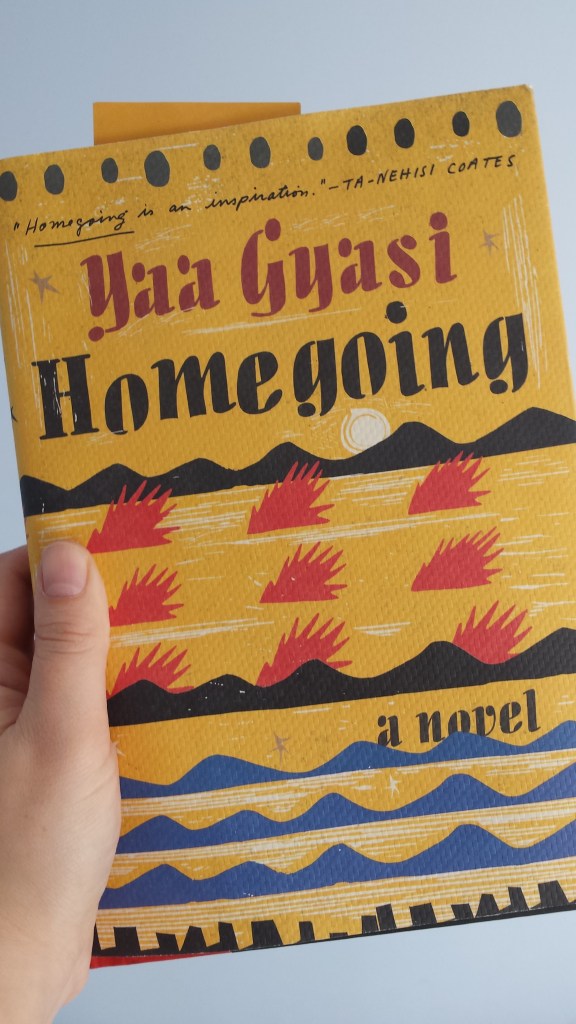
Homegoing by Yaa Gyasi. A friend and I didn’t just talk about doing it; we actually started a book club this year. This book was a good choice for a first pick, as it’s multiple perspectives provided for an interesting discussion.

The book with the most interesting structure

The Party Wall by Catherine Leroux. This is a beautiful novel of interconnected stories about siblings and includes several unexpected turns.

The debut novel I loved the most

The Fishermen by Chigozie Obioma. I read a lot of debut novels this year, but I absolutely loved this captivating tale of four brothers growing up in Nigeria, and it deserves a special mention.

The books I couldn’t put down

By the numbers

Books I bought: 41% (bought new: 33%, bought used: 8%)

Books borrowed from the library: 39%

Books received as gifts: 14%

Books won as prizes: 4%

Books borrowed from friends: 2%

Books written by Canadian writers: 35%

Books written by women: 67%

Books written by men: 33%

Books published in 2016: 37%

Fiction: 94%

Non-fiction: 6%

Lessons learned

I really don’t read much non-fiction.

Because of this, I’d like to read more non-fiction in 2017 (even though I suspect I’ll always love fiction more than non-fiction, and I still expect the ratio will be unbalanced).

It can be good to try an author you’ve been avoiding.

It seems silly now that I thought I wouldn’t enjoy Murakami. It’s possible that Kafka on the Shore was a one-off, but I certainly plan to read another of his books.

Books provide awesome therapy.

I knew this before, but it was reinforced this year. 2016 was a roller coaster, and I’m convinced the lows would have been much lower if I didn’t have books and that the highs wouldn’t have been as good either.

It doesn’t matter how many (or how few) books you read.

I’ve always felt this way, but this year I found myself paying more attention to the number of books I read than I’ve done in previous years. It was fun at times, keeping track of books this way. But I also found that, because I was paying attention to it, I’d sometimes feel bad if it took me longer to read something than I felt it should. But some books are supposed to slow you down. Sometimes you can get more out of a book if you read it slowly, and I want to remember that.

Now to start thinking about what books to read in 2017…

The portrayal of family and mental illness in Imagine Me Gone

20161218_135941

What I read

Imagine Me Gone by Adam Haslett

What it’s about

Margaret learns about John’s depression before she marries him, but it doesn’t keep her from wanting to build a life with him. They have three children, one of whom experiences another serious mental illness. Imagine Me Gone follows the family of five over several decades, with chapters alternating between the perspectives of each family member.

This novel beautifully portrays a family who not only cares about each other but who care for each other. While the story illustrates how mental illness affects a family, it also explores the love, loyalty and devotion in various relationships.

Why I picked it up

I can’t remember where I first heard about Imagine Me Gone, but I read about it several times before I stumbled across a copy in the bookstore. There was something about the white cover and the missing letters that caught my eye. Still, it took a few more bookstore visits before I bought the novel.

The subject of mental illness appealed to me, and I do enjoy books that explore familial relationships. But I hesitated because this type of subject matter is something so many writers could get wrong, and I suppose I also thought the book could be too dark. But earlier this month, I couldn’t resist its appeal and I bought a copy.

What I liked about it

Haslett’s prose is stunning. As with Donna Tartt’s The Goldfinch, Imagine Me Gone moves at a pace that made it almost impossible for me to put down, and yet it also made me want to reread sentences or paragraphs because of the beautiful wording.

I was impressed with how Haslett managed to write about complicated subject matter and complicated feelings without making it feel complicated to read. He smartly inserts humour into the story that helps with this.

Haslett also does a great job of giving each of the family members their own distinct voice. The inner thoughts and feelings of each of the five family members is captured brilliantly.

This is such an honest book. It never felt over-written, exaggerated or pretentious. I’m so glad I picked it up.

You’ll want to read it if…

This is definitely a book for fans of literary fiction. It’s a particularly good choice if you like novels that move between perspectives of several characters. And if you enjoy stories that examine family dynamics or sibling relationships, you should read this book.

Recommended refreshments

I read most of this book on one very cold December afternoon. Part of that afternoon was spent inside a cozy cafe with a mug of hot chocolate. I highly recommend this experience for anyone reading Imagine Me Gone.

Homegoing: an impressive debut

20161111_092100What I read

Homegoing by Yaa Gyasi

What it’s about

Homegoing opens in Ghana in the mid-18th century and tells the stories of two half-sisters, who never meet, and follows the lineage of each sister up to present day. Each chapter serves as a window into the lives of one of the sisters’ descendants.

The book begins with a chapter for each of the sisters. Effia is forced to marry a British slaver, and Esi is sold into slavery. Subsequent chapters alternate between Effia’s and Esi’s family lines and compare and contrast the lives of the characters in Ghana and in America.

Why I picked it up

I suggested this title to my book club, and the group thought it would be a good choice, so we read it. I’m not sure where I first heard of Homegoing. I only know that I read about it online in a few different places before I suggested it to our book club. I liked the premise, of following the lineage of the sisters over time. I happily purchased a copy from my favourite bookstore.

What I liked about it

In general, I liked the structure of this book. I loved the interconnectedness of the stories, and how oftentimes the characters from past chapters would show up as secondary characters in later chapters. I liked following the families through generations, and seeing the connections between characters who never met.

But while I liked the structure, it did leave me with a couple of frustrations. At times it was hard to keep track of how the characters were connected. (A family tree at the front of the book helped with this, and I was flipping back to it quite a bit.) My other frustration was that there were times when I wanted to stay with a character or story a bit more than Gyasi allowed–not because it felt like she had moved on too quickly, but because she did such a good job with them.

The story I was most captivated with while I read the book, and that stands out to me the most now upon reflection, is the story of H., a convict worker in a coal mine in the south. But each chapter is there for a reason, addressing themes of colonization, enslavement, racism and identity, to name a few.

You’ll want to read it if…

You should read Homegoing if you like historical fiction (or history) and/or novels-in-stories. It’s also a good choice if you’re a fan of family sagas.

It’s not really a good choice if you’re looking for something light. I’m not just referring to serious themes that are addressed. There’s some work involved in keeping the characters straight. It’s also maybe not the best choice if you really want to spend time with a single character and watch them develop over time.

Recommended refreshments

Our book club talked about Homegoing with some red wine and cheese on hand. I don’t know if the refreshments had anything to do with how the meeting went, but we did have some interesting conversation. And, really, wine and cheese is often a good idea.

Looking at Mona Awad’s first novel

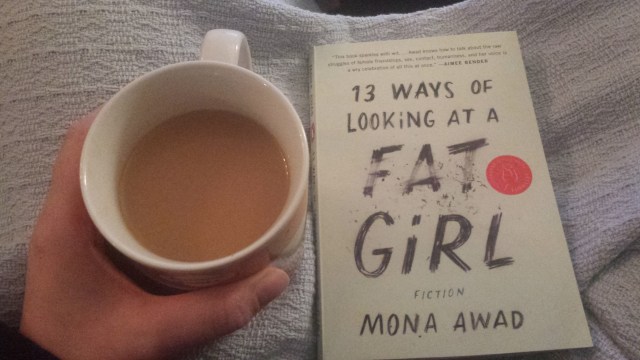
20161023_200816What I read

13 Ways of Looking At a Fat Girl by Mona Awad

What it’s about

Set in Misery Saga (Mississauga, Ontario), this book follows Lizzie (aka Liz, Beth, Elizabeth) through her teenage years to adulthood as she struggles with her weight. We get thirteen different stories, thirteen glimpses of Lizzie at a different stage in her life, that explore her relationship with her body, her friends and her mother. We see Lizzie as a fat girl and then as a woman who has succeeded in losing the weight but who continues to struggle with how she sees food and her body. This book explores themes of body image, girlhood and relationships of all different kinds.

Why I picked it up

While I haven’t been making a conscious effort to read the titles on this year’s Giller Prize shortlist, this is the third of the six titles I’ve read. But I’ve actually wanted to read this book for a while. As I’ve mentioned before on this blog, I really enjoy coming-of-age stories, and I’ve also been reading a lot of Canadian literature this year. I’ll also admit that the allusion in this title to Wallace Stevens’ poem “Thirteen Ways of Looking at a Blackbird” caught my attention. Anyway, after being on my TBR list for several months, I picked up a copy a few weeks ago.

What I liked about it

The structure. This novel composed of thirteen interconnected stories works very well. Each piece works as a standalone story, offering profound moments in Lizzie’s life. Reading them together as a novel provides us with a strong sense of Lizzie throughout her life, having each story build on the next, letting us see how each of these moments affects her later in life.

Awad has done an excellent job with voice and tone in this book, too. Lizzie is relatable in all thirteen stories, as a teen and as an adult. And while there is humour in this book and plenty of funny moments, Awad also doesn’t hold back, confronting some serious subject matter that can at times be uncomfortable.

You’ll want to read it if…

Fans of short stories or lovers or coming-of-age tales will like this one. It’s even better if you like both of those genres.

Recommended refreshments

It will come as no surprise that food is mentioned  a lot in this book. What immediately comes to mind is all the salad mentioned in this book, but it hasn’t made me crave any of it. I can also strongly see Lizzie’s French fries served with ketchup and mayonnaise, but I don’t find that image very appetizing. But the squares of dark chocolate Lizzie allows herself do sound good. So I recommend a bit of chocolate…and, of course, a cup of tea.