Behold the Dreamers: a fantastic debut novel

20161018_211445

What I read

Behold the Dreamers by Imbolo Mbue

What it’s about

Behold the Dreamers takes place in New York City in 2008. The story opens as Jende Jonga gets a job as a chauffeur for Clark Edwards, a Lehman Brothers executive. Jende is thrilled to have landed such a good job after bringing his family over to America from Cameroon. His wife, Neni, has a student visa and is studying to become a pharmacist and is hired for some temporary work by Clark’s wife, Cindy. Jende and Neni work hard to make the life they have dreamed of for themselves and their young son a reality. But when Lehman Brothers goes bankrupt, and the recession begins, things change quickly and dramatically for both the Edwardses and the Jongas.

The story examines themes of race and class, about identity and how much our identity is tied with place. It’s about the quest for home and belonging. It’s also about the struggles families, couples and individuals face behind closed doors.

Why I picked it up

Before purchasing this book, I’d seen the title on a few lists previewing books for the fall. I’ve been reading a lot of Canadian literature lately, and I wanted to read a story from the perspective of a different culture.

What I liked about it

Mbue does a masterful job of creating a sense of empathy for the characters in this book. The pressures Jende feels to provide for his family in New York and for his family back in Cameroon, Neni’s struggle with deciding what is the right thing to do as a mother, Cindy’s inner turmoil–I felt like these were real people and not fictional characters. There is a scene between the Jongas’ son, Liomi, and Neni after Neni has been to a parent-teacher meeting. The description of how Liomi feels as Neni lectures him felt very real, and I wanted to reach out to Liomi to give him a hug.

The major events in this book–the recession, the Lehman Brothers going bankrupt, Obama getting into office–are all from recent history. It was interesting to read about these things with just a few years’ perspective, to be able to remember them from reality and to anticipate what will happen in the novel.

You’ll want to read it if…

This is a good choice for readers who want something more realistic than a feel-good story of people settling in America and living the American dream. It’s also a book for fans of literary fiction: The story focuses on the emotional challenges and intellectual struggles the characters experience.

Recommended refreshments

There were plenty of mentions about African food, such as fried plaintains and puff-puff. I haven’t eaten either, but I’ve since looked up what puff-puff is, and it sounds like a more delicious version of a doughnut. So while I haven’t eaten it myself, I’d say puff-puff seems like the perfect snack to enjoy while reading Behold the Dreamers.
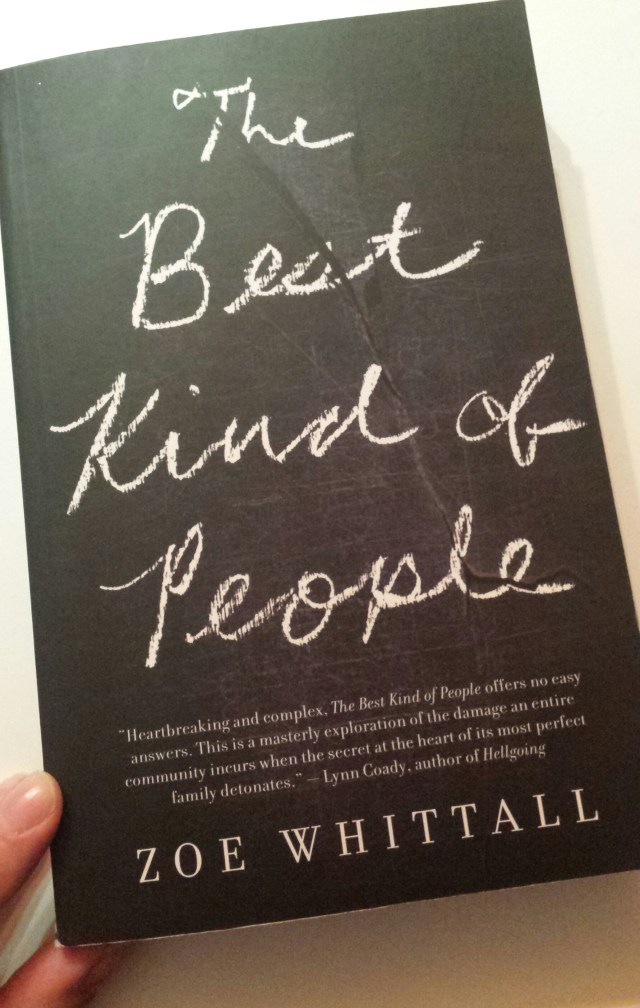
The Best Kind of People and the voices we need to hear

20161005_180516-1

What I read

The Best Kind of People by Zoe Whittall

What it’s about

The Best Kind of People is set in modern-day America and tells the story of a family whose patriarch, George Woodbury–a well-respected and admired schoolteacher–has been accused of sexual misconduct. But instead of telling the story through George’s perspective, or through the victims’, the novel looks at how George’s family and the community are affected.

Written in the third person, The Best Kind of People moves between the perspectives of George’s wife, son and daughter. The novel examines the complex feelings and thoughts the family experiences and also looks at the reactions of the community and media that the family must face.

Why I picked it up

In addition to the intriguing premise, I wanted to read The Best Kind of People since I’ve also read Whittall’s first novel, Bottle Rocket Hearts, and liked her writing style.

The Best Kind of People was already receiving quite a bit of buzz–and had made it onto the 2016 Giller Prize longlist–by the time I picked up a copy from House of Anansi’s tent at Word on the Street. The day after the festival, it was announced that the book made the shortlist (as did Emma Donoghue’s The Wonder, which I’ve also read and reviewed.)

What I liked about it

If Whittall had written this novel from the point of view of George or of the victims, it would have been a different book entirely. What makes this story so interesting is that we get to hear the voices of those we don’t usually hear from, whether that be in other books or in the news. There is a lot of inner conflict that’s explored here: the complex feelings and thoughts that each family member deals with. But the book also shows how those feelings and thoughts can vary for each family member. I couldn’t stop reading this one.

You’ll want to read it if…

This is a book for lovers of literary fiction. You’ll want to read it if you like delving into the minds and hearts of characters and going on their intellectual and emotional journeys. There are, of course, events that happen along the way, but what Whittall does so well is illustrate the inner struggles experienced by the characters. It’s one of those books that asks more questions than it provides answers.

Recommended refreshments

I recommend my old standby: a good cup of tea. I just hope yours is better than some of the tea references that I can recall in this book (an unappetizing cup of herbal tea, or a cuppa that’s been steeped for too long and is undrinkable). So choose your tea wisely–and brew it properly.

Emma Donoghue’s The Wonder is hard to put down

20160929_210540

What I read

The Wonder by Emma Donoghue

What it’s about

Set in the mid-1800s, an English nurse, Lib Wright, is called to Ireland to observe 11-year-old Anna, who has gone months without eating. Anna is becoming known as a miracle child, as many of the Irish Catholics around her believe she must be chosen by God to have survived this long without sustenance.

Lib’s task isn’t to care for the girl but to simply watch Anna over a two-week period, exchanging shifts with a nun, to confirm that Anna is not eating. Non-religious Lib believes she will uncover a hoax, but what she ends up uncovering instead results in her trying to save the girl, despite her orders.

Why I picked it up

Donoghue has written many books, but Room was the only one I’d read before The Wonder. Room was hugely successful and was made into a film, which Donoghue herself wrote the screenplay for.

Reading Room was enough to show me what a good writer and storyteller Donoghue is, but I’m not sure it would have been enough to make me pick up The Wonder. However, I knew I would be attending Donoghue’s talk at the Toronto Public Library, and I while I book-browsed one day, I decided to start reading the novel before the event.

What I liked about it

Donoghue does a good job of creating suspense in this book. I read the first 100 pages of The Wonder over a few days, and then the last 190 pages all at once. The plot went in places I didn’t expect, but they were always places that worked well, and my interest kept increasing as I read.

There is a strong sense of setting here, of being inside that room with Lib and Anna. There is a feeling of darkness, a sense of gloominess that comes with well-written gothic tales.

You’ll want to read it if…

The Wonder is a good choice if you like historical novels with a mystery involved. Like Room, this book confronts some difficult subject matter, so it might not be the best choice if you’re looking for something light, but it’s definitely a book that will stay with you after you’ve put it on the shelf.

Recommended refreshments

Food is obviously a main subject in this book, but it’s more about the absence of it. To stay on theme, you could try reading this book with only a few teaspoons of water. But that’s not a reading experience I can recommend. Instead, maybe grab a mug of hot cocoa. It might warm you up if a chill or two runs down your spine.

Cordelia Strube’s latest novel shines

20160905_192749

What I read

On the Shores of Darkness, There Is Light by Cordelia Strube

What it’s about

The story centres around Harriet, an 11-year-old artist who is independent and resourceful, and her little brother, Irwin, whose medical condition is the focus of their mother’s and stepfather’s attention. Harriet plans to escape her family and head to Algonquin Park, where she can live and paint like Tom Thomson. But not everything works out the way Harriet plans.

This is a story that explores the complexities and imperfections within families. It’s a story that’s sad and tragic, but there’s lots of humour inserted that gives the narrative balance and also makes it true to life. There is darkness, and there is light.

How I got my hands on it

I quite enjoyed Strube’s last two novels–Milosz and Lemon–so the author was on my radar. I knew I wanted to read this one when it was released earlier this year, but I only recently picked up a copy at my favourite independent bookstore.

What I liked about it

As with Lemon, Strube does a fantastic job of creating interesting and complex young female characters. But it’s not just Harriet’s story that kept me reading. There are so many fascinating and flawed characters in this book and several subplots. There is a well-executed twist in this book, too. Who can resist a good literary twist?

You’ll want to read it if…

This is a great book to pick up if you like stories about families and especially about sibling relationships. If you live in, have lived in, or have a fascination with Toronto, you might get a kick out of the mentions of many of the city’s landmarks, too.

Recommended refreshments

In the book, Harriet often visits a convenience store where the owner gives her some of the damaged treats he can’t sell. So I suggest opening a bag of broken Doritos, biting into a smashed Caramilk bar, or, if it’s a lucky day, guzzling down a bottle of Orangina.

Musings on The Muse

20160821_203133

What I read

The Muse by Jessie Burton

What it’s about

In 1967, 26-year-old Odelle Bastien has taken a job as a typist at the Skelton Art Gallery in London, England, after moving from Trinidad a few years earlier. Soon after starting to work in the gallery, Odelle encounters a painting that connects her with southern Spain in 1936. Odelle is compelled to piece together the mystery behind the subject of the artwork, the artist who painted it and the story of how it ended up where it did. 

The novel follows two narratives–one taking place in 1967 and the other in 1936–and demonstrates the power of art and how art is bigger than, and separate from, the artist.

How I got my hands on it

I first heard about Burton through the Twitter account of her literary agent, Juliet Mushens, when Burton’s first novel, The Miniaturist, came out two years ago. The Miniaturist received much acclaim, but I didn’t read it because the premise didn’t interest me. But when I started hearing things about The Muse, it piqued my interest. I bought my copy at my favourite independent bookstore.

Things I liked about it

I love stories that show interconnectivity between people, time periods or geographical locations, and this book does all three. What’s more, the story makes these connections through discussing art–an ekphrastic tale of sorts. Also, Burton does an excellent job of placing the reader in two separate time periods and locations; there’s a different feeling and landscape to each narrative.

I also like that while Odelle and the reader put together the story of the painting, not all details are left neat and tidy. It makes for a satisfying ending that’s also realistic.

You’ll want to read it if…

You might enjoy The Muse if you’re a fan of art, mysteries or historical fiction. And if you like all three, that’s even better.

Recommended refreshments

Gin and tonic with a slice of lemon. That’s what Odelle and her new boss partake in when they have lunch during Odelle’s first week at the gallery. And, really, art and libations are a classic pairing.