4 ways fiction can help you get through the darkness 

20161120_162817We’ve entered a very dark time of year, and I mean that literally. Please don’t shoot the messenger, but we’ve got another month to endure before it (slowly) starts getting lighter in the evenings again.

Whether or not you are someone whose mood and well-being are affected by seasonal changes, we all experience figurative darkness at some point. I won’t suggest there is an easy fix for emotional and mental troubles, but a good book can help us navigate through difficult times, or provide a bit of comfort.

So even though you might want to hibernate over the next few months, I strongly suggest you first make your way to your local library and/or bookstore and stock up.

Here are a few ways reading fiction can help you through you a rough time.

It provides emotional support

This is like having a good friend to lean on/cry to. The friend in this case just happens to be fictional. Reading about characters who are experiencing an issue or a feeling that you are can help you realize you’re not the only one going through that. Also, it can be helpful to have an author articulate things you are feeling but don’t know how to put into words.

It can offer potential solutions

You might want more than empathy when reading about a character with an experience familiar to your own. You might want to see what you can do to better your situation. This works particularly well if you’re dealing with a practical dilemma. In this case, you read to see how others have handled situations like yours and consider whether that might work for you.

It helps you consider the experiences of others

You might find it useful to take some of the energy you’ve invested in mulling over your own problems and transfer it to over to think about someone else’s. It gives you a bit of a break from your own troubles, and it can feel good to think and care about another person (even if they are fictional).

 It will entertain you

This seems simple and obvious, but we can put a lot of pressure on the fiction we read. With any kind of art, we might expect it to teach us something, show a different viewpoint or even cause us to have some sort of epiphany. But reading fiction is also important for the fact that it’s entertaining. As human beings, we enjoy stories. A good story might make us laugh, or keep us in suspense, or transport us into another world. Good stories are entertaining. They give us joy. And that might be enough of a reason to get cozy with a stack of books that will keep us busy even after we’ve caught a glimpse of the light.
The Magnificent Six and the 2016 Giller Prize

20161106_162541

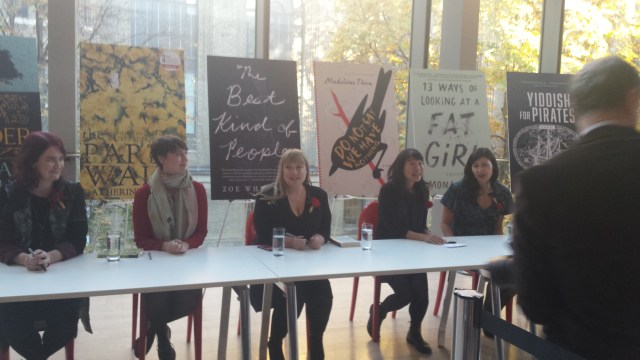
Five of the six 2016 Giller Prize finalists (the sixth is behind that man!). From L-R, Emma Donoghue, Catherine Leroux, Zoe Whittall, Madeleine Thien, Mona Awad and the man blocking Gary Barwin.

How normal is it for a reader to get this excited about a literary prize? Because, truthfully, I haven’t really experienced this in the past. But tomorrow the winner of the 2016 Giller Prize will be announced, and I can’t wait to find out who wins.

I’ve read three of the six shortlisted titles (read my reviews of Mona Awad’s 13 Ways of Looking at a Fat Girl, Emma Donoghue’s The Wonder and Zoe Whittall’s The Best Kind of People), and all three are incredible books. But the reason I picked up each of these titles wasn’t because they made the shortlist. I don’t think I’ve ever read a book just because it was nominated for, or won, a prize. But when books are nominated, they obviously get some more publicity, so I’m more likely to hear about it. And no matter how I find out about a book, if it grabs me, I’ll read it.

Today I attended the Giller Prize Between the Pages event at Koerner Hall in Toronto. The six finalists read from their nominated books and discussed their work. After today, I wouldn’t be surprised if I pick up the three shortlisted titles I haven’t yet read (Gary Barwin’s Yiddish for Pirates, Catherine LeRoux’s The Party Wall and Madeleine Thien’s Do Not Say We Have Nothing). They all sound like great books.

The discussion portion of the event (moderated by actor and director Albert Schultz) was fun and insightful. I love hearing writers talk about writing. When Schultz asked the group if they were nervous, Donoghue answered that it’s easier now that the authors have spent some time together and have gotten to know each other. They approach these things “like a gang.” A gang of authors–what a beautiful idea.

Tomorrow should be a long day for the Giller Prize jury, as that’s when they will choose the winner. I’ve read only half of the shortlisted titles, and it would be difficult for me to pick from those three. I don’t imagine it will be easy for them to decide.

Watch it all go down tomorrow at 9 p.m. on CBC Television or via live stream on CBC Books…and read the books written by this wonderful gang of authors, the Magnificent Six.

Looking at Mona Awad’s first novel

20161023_200816What I read

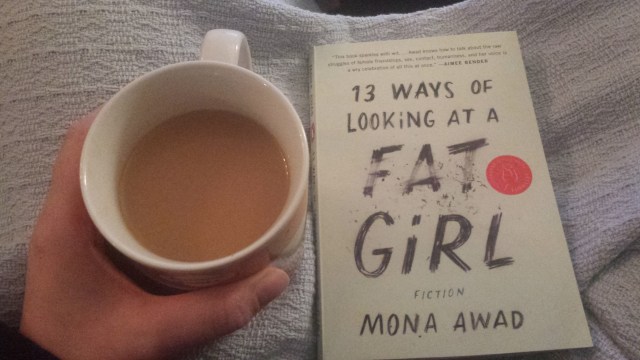
13 Ways of Looking At a Fat Girl by Mona Awad

What it’s about

Set in Misery Saga (Mississauga, Ontario), this book follows Lizzie (aka Liz, Beth, Elizabeth) through her teenage years to adulthood as she struggles with her weight. We get thirteen different stories, thirteen glimpses of Lizzie at a different stage in her life, that explore her relationship with her body, her friends and her mother. We see Lizzie as a fat girl and then as a woman who has succeeded in losing the weight but who continues to struggle with how she sees food and her body. This book explores themes of body image, girlhood and relationships of all different kinds.

Why I picked it up

While I haven’t been making a conscious effort to read the titles on this year’s Giller Prize shortlist, this is the third of the six titles I’ve read. But I’ve actually wanted to read this book for a while. As I’ve mentioned before on this blog, I really enjoy coming-of-age stories, and I’ve also been reading a lot of Canadian literature this year. I’ll also admit that the allusion in this title to Wallace Stevens’ poem “Thirteen Ways of Looking at a Blackbird” caught my attention. Anyway, after being on my TBR list for several months, I picked up a copy a few weeks ago.

What I liked about it

The structure. This novel composed of thirteen interconnected stories works very well. Each piece works as a standalone story, offering profound moments in Lizzie’s life. Reading them together as a novel provides us with a strong sense of Lizzie throughout her life, having each story build on the next, letting us see how each of these moments affects her later in life.

Awad has done an excellent job with voice and tone in this book, too. Lizzie is relatable in all thirteen stories, as a teen and as an adult. And while there is humour in this book and plenty of funny moments, Awad also doesn’t hold back, confronting some serious subject matter that can at times be uncomfortable.

You’ll want to read it if…

Fans of short stories or lovers or coming-of-age tales will like this one. It’s even better if you like both of those genres.

Recommended refreshments

It will come as no surprise that food is mentioned  a lot in this book. What immediately comes to mind is all the salad mentioned in this book, but it hasn’t made me crave any of it. I can also strongly see Lizzie’s French fries served with ketchup and mayonnaise, but I don’t find that image very appetizing. But the squares of dark chocolate Lizzie allows herself do sound good. So I recommend a bit of chocolate…and, of course, a cup of tea.

Behold the Dreamers: a fantastic debut novel

20161018_211445

What I read

Behold the Dreamers by Imbolo Mbue

What it’s about

Behold the Dreamers takes place in New York City in 2008. The story opens as Jende Jonga gets a job as a chauffeur for Clark Edwards, a Lehman Brothers executive. Jende is thrilled to have landed such a good job after bringing his family over to America from Cameroon. His wife, Neni, has a student visa and is studying to become a pharmacist and is hired for some temporary work by Clark’s wife, Cindy. Jende and Neni work hard to make the life they have dreamed of for themselves and their young son a reality. But when Lehman Brothers goes bankrupt, and the recession begins, things change quickly and dramatically for both the Edwardses and the Jongas.

The story examines themes of race and class, about identity and how much our identity is tied with place. It’s about the quest for home and belonging. It’s also about the struggles families, couples and individuals face behind closed doors.

Why I picked it up

Before purchasing this book, I’d seen the title on a few lists previewing books for the fall. I’ve been reading a lot of Canadian literature lately, and I wanted to read a story from the perspective of a different culture.

What I liked about it

Mbue does a masterful job of creating a sense of empathy for the characters in this book. The pressures Jende feels to provide for his family in New York and for his family back in Cameroon, Neni’s struggle with deciding what is the right thing to do as a mother, Cindy’s inner turmoil–I felt like these were real people and not fictional characters. There is a scene between the Jongas’ son, Liomi, and Neni after Neni has been to a parent-teacher meeting. The description of how Liomi feels as Neni lectures him felt very real, and I wanted to reach out to Liomi to give him a hug.

The major events in this book–the recession, the Lehman Brothers going bankrupt, Obama getting into office–are all from recent history. It was interesting to read about these things with just a few years’ perspective, to be able to remember them from reality and to anticipate what will happen in the novel.

You’ll want to read it if…

This is a good choice for readers who want something more realistic than a feel-good story of people settling in America and living the American dream. It’s also a book for fans of literary fiction: The story focuses on the emotional challenges and intellectual struggles the characters experience.

Recommended refreshments

There were plenty of mentions about African food, such as fried plaintains and puff-puff. I haven’t eaten either, but I’ve since looked up what puff-puff is, and it sounds like a more delicious version of a doughnut. So while I haven’t eaten it myself, I’d say puff-puff seems like the perfect snack to enjoy while reading Behold the Dreamers.

The Best Kind of People and the voices we need to hear

20161005_180516-1

What I read

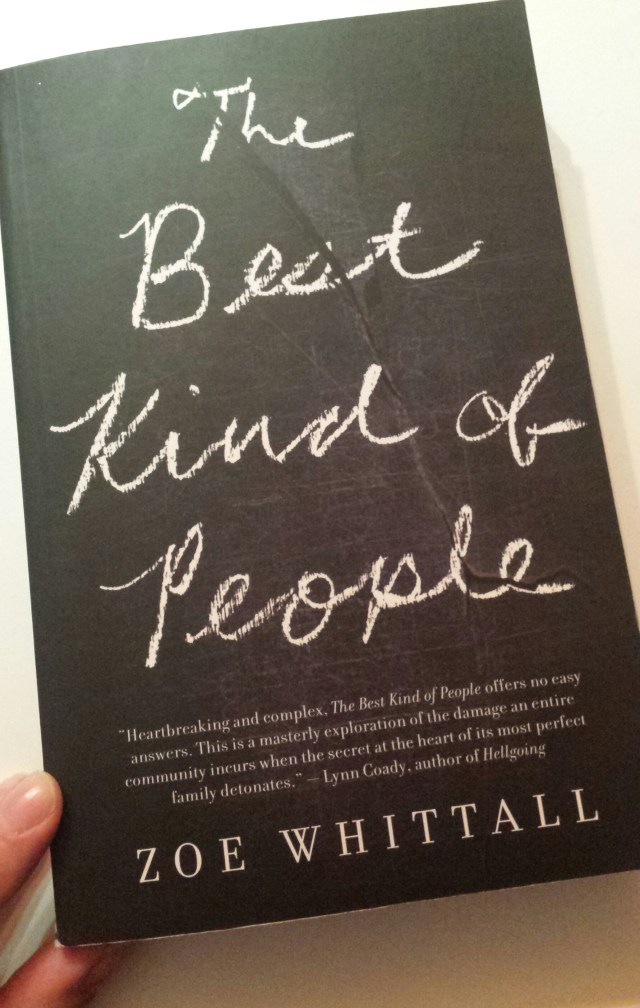
The Best Kind of People by Zoe Whittall

What it’s about

The Best Kind of People is set in modern-day America and tells the story of a family whose patriarch, George Woodbury–a well-respected and admired schoolteacher–has been accused of sexual misconduct. But instead of telling the story through George’s perspective, or through the victims’, the novel looks at how George’s family and the community are affected.

Written in the third person, The Best Kind of People moves between the perspectives of George’s wife, son and daughter. The novel examines the complex feelings and thoughts the family experiences and also looks at the reactions of the community and media that the family must face.

Why I picked it up

In addition to the intriguing premise, I wanted to read The Best Kind of People since I’ve also read Whittall’s first novel, Bottle Rocket Hearts, and liked her writing style.

The Best Kind of People was already receiving quite a bit of buzz–and had made it onto the 2016 Giller Prize longlist–by the time I picked up a copy from House of Anansi’s tent at Word on the Street. The day after the festival, it was announced that the book made the shortlist (as did Emma Donoghue’s The Wonder, which I’ve also read and reviewed.)

What I liked about it

If Whittall had written this novel from the point of view of George or of the victims, it would have been a different book entirely. What makes this story so interesting is that we get to hear the voices of those we don’t usually hear from, whether that be in other books or in the news. There is a lot of inner conflict that’s explored here: the complex feelings and thoughts that each family member deals with. But the book also shows how those feelings and thoughts can vary for each family member. I couldn’t stop reading this one.

You’ll want to read it if…

This is a book for lovers of literary fiction. You’ll want to read it if you like delving into the minds and hearts of characters and going on their intellectual and emotional journeys. There are, of course, events that happen along the way, but what Whittall does so well is illustrate the inner struggles experienced by the characters. It’s one of those books that asks more questions than it provides answers.

Recommended refreshments

I recommend my old standby: a good cup of tea. I just hope yours is better than some of the tea references that I can recall in this book (an unappetizing cup of herbal tea, or a cuppa that’s been steeped for too long and is undrinkable). So choose your tea wisely–and brew it properly.