The Girls: a tale of teenage loneliness and grisly murder

20160729_163907

What I read

The Girls by Emma Cline

What it’s about

This debut novel follows 14-year-old Evie Boyd during the summer of 1969 when she is drawn to a group of girls—and one in particular—who belong to a cult. The story is inspired by the Manson family and the murders they committed, but it’s about more than that: Most notably it’s a story about teenage loneliness—of wanting to be seen by someone, anyone—and it explores the dynamic of female relationships.

How I got my hands on it

The Girls came up in conversation at work. When I mentioned I was interested in reading it, a coworker was nice enough to lend me her copy.

Things I liked

All I really knew about this book before I read it was that it was about a young girl who joins a cult and that it was inspired by the Manson family. That premise intrigued me. But I didn’t expect that I would enjoy Cline’s style of writing as much as I did. While she may have overdone it in places, many of her metaphors and descriptions were beautiful.

The structure of the book is also worth mentioning. The story interweaves the present—where a middle-aged Evie reflects on the past—with the summer of 1969. The parts of the book that take place in the present are not as interesting or as powerful as the parts that take place in the past, but Cline gets the balance right. And when we are in those present-day sections, Evie feeds us tidbits of details of what ends up happening, providing bait that I eagerly bit into.

You’ll want to read it if…

If, like me, you’re fond of coming-of-age stories, you’ll like this book. This is also a good read if you’re someone who likes psychological books—if you like to try to get into the mind of someone who does something you can’t fathom.

And if you’re avoiding it because of its gruesome inspiration, I’d ask you to reconsider. The story is really more about searching for identity, looking for a place to belong and trying to connect with another person.

Recommended refreshments

The first thing that comes to mind is a tall glass of OJ. This might be partly because of the California setting, but there are a few mentions of orange juice in the book. Granted, usually it’s mentioned to remark upon its absence (someone going to get orange juice but not bringing it back, a description of a splash of OJ in a glass filled with vodka). Maybe that’s symbolic of the absence of sunshiny optimism, or the disappearance of the innocence of youth. Or maybe I’m giving it too much thought. In any case, the pot of Earl Grey tea seen in the above photo suited me just fine, so that’s an option, too.
7 myths about working with words

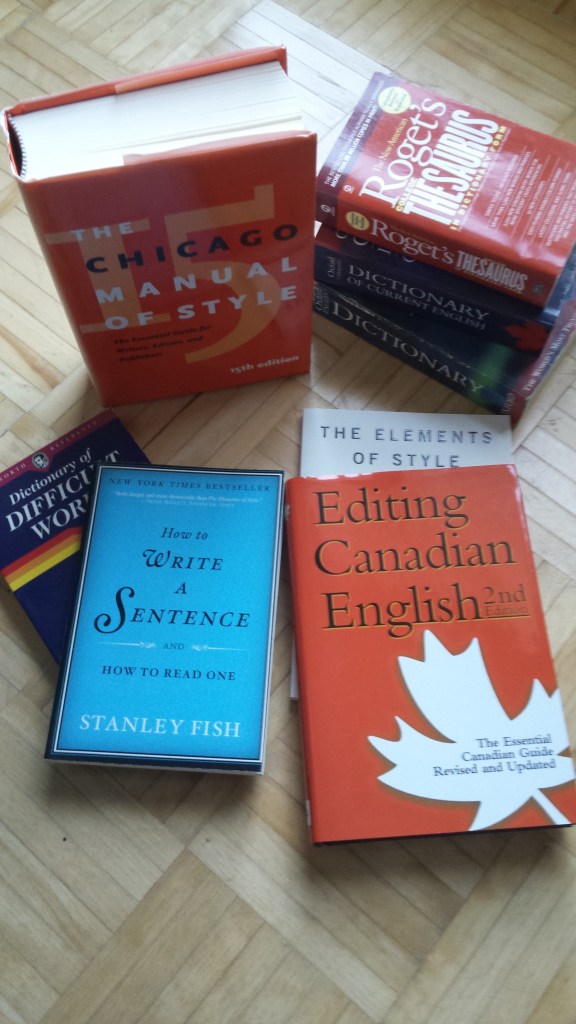
dictionaries and language resource materials

Words, punctuation, grammar—these are a few of my favourite things. I’ve worked as a proofreader, writer, transcriber and editor, and, throughout my career, I’ve come across some misconceptions about what it takes to do this type of work. Here are seven myths about what it takes to be a professional word nerd.

Myth 1: You work best on your own.

This is true for a lot of word nerds for at least some of the time. But editors, writers and proofreaders really thrive when they have a network to turn to. We don’t always know the best way handle a situation, or maybe we’ve spent so much time on something and could use a fresh set of eyes on it. It can be helpful to get another opinion (or a few).

Myth 2: You feel strongly about the serial comma.

When you work with words, people often assume you feel passionately about the serial comma. But the value of this tiny mark has been blown out of proportion. What’s important is being consistent and clear with your communications, and this is possible whether or not you use the serial comma.

Working as an editor or writer means you will likely work with style guides maintained by someone other than yourself. You need to be flexible. You’ll probably use the serial comma for some work and you won’t for other work, and you’ll realize that either way is fine.

Myth 3: You are (or could be) a spelling bee champion.

You don’t need to know how to spell every word in the English language, but you definitely need to know to look them up. Yes, having a large vocabulary is helpful, but no matter how much you know, you should continue to consult your trusty dictionary. With this type of work, paranoia can be a good thing, because it’s when you get too confident that you start to miss stuff.

Myth 4: You won’t stand for people breaking language “rules.”

You might hate seeing “they” used as a singular pronoun, or maybe you can’t stand comma splices, but you understand that how we use language evolves. Maybe you’re proud of knowing how to use “whom” properly, but you also realize the word is rarely used now. Keeping the reader in mind is more important than showing off.

Myth 5: You love detail.

It’s not necessary to love detail, but it’s necessary to notice detail. It’s something hardwired in our brains, and it doesn’t mean we actually like it. It can be a bit of a curse sometimes. We can pore over a small detail that maybe no one else will notice, but we do it because we can’t rely on “maybe” and because we strive to create the clearest writing possible.

Myth 6: You enjoy correcting people’s grammar, spelling, etc.

A good editor or proofreader isn’t going to correct friends during a casual conversation. Corrections are saved for written work and only when that’s what we’ve been asked to do professionally. Even then, we don’t like pointing out inconsistencies or errors. Our goal is to make the piece the best it can be.

Myth 7: You don’t make mistakes.

I’ve had co-workers, friends and relatives tell me they get nervous emailing me because they think I’ll judge them if the message contains errors. And, yes, if there are so many errors that I can’t understand what the email means, I am likely to notice. But we all make mistakes sometimes—even the best copy editors. So try to make the best written communications possible, but it doesn’t mean you have to be perfect yourself.

A little disappointed with A Little Life

20160717_101554

What I read

A Little Life by Hanya Yanagihara

What it’s about

A Little Life follows four friends who meet in college and move to New York after leaving school. The story centres around Jude, whose life is filled by one horrific experience after another, and his struggle to endure the traumas he faces. The people closest to Jude try to help him survive.

How I got my hands on it

Sometimes I like to go to the bookstore and pick something out on a whim. Other times, there’s a title I’ve heard and read so much about that I need to see what all the fuss is about. With A Little Life, it was the latter.

I had been excited to read this one for a while, as I’d heard how readers couldn’t put it down, how people were having such emotional reactions to it that they couldn’t go to sleep. Sometimes books that make me cry my eyes out are just what I’m looking for. So when I had some vacation time coming up, I went to my favourite independent bookstore and picked up a copy.

What I liked (and what I didn’t like)

The writing is set a good pace. Even though A Little Life is 800+ pages, it has taken me longer to read shorter books. The subject matter might be dark and heavy, but the writing isn’t dense.

But even though the story held my attention, I mostly did not like this book. This was partly because I was expecting (and looking forward to) a story about four friends and the dynamics of their friendship, and it turned out to be mostly about Jude and how the other three friends try to help him survive all the terrible things that happen to him.

Also, while awful things happen to Jude, I just didn’t sympathize with him. I was so conscious that I was reading about a fictional character. I didn’t connect with him the way I do with protagonists in books I love, where I feel as though the character is a real person I know.

However, I admit that, for a book I didn’t like all that much, I’ve definitely been thinking about it. Mostly I’ve been trying to figure out what other people saw that didn’t resonate with me. This hasn’t changed my feelings about the book, but it’s different from other books I don’t care for, when I don’t give it another thought after turning the final page.

You’ll want to read it if…

I’m tempted to say that you’d like A Little Life if you like depressing books, but I’m not sure that’s enough. I mean, I like depressing books, too. Thomas Hardy’s Jude the Obscure is a perfect example of this. (Is it a coincidence that Yanagihara chose the same first name for her protagonist?) But I can say with certainty that you shouldn’t read this if you don’t like depressing books. It’s pretty bleak.

Recommended refreshments

There are several mentions of food in A Little Life. Jude bakes and cooks and even works in a bakery at one point. There are descriptions of Thanksgiving dinner and other meals. But with some of the disturbing subject matter, it’s hard for me to recommend enjoying any of the foods mentioned in the book while you read it. Instead, you might try a peppermint tea for a bit of comfort and to help settle the stomach.

The beauty of Wild Dogs

What I read

Wild Dogs by Helen Humphreys

What it’s about

A group of strangers have something in common: Their dogs have left their domestic lives and now roam in the wild as a pack. The group gathers near the forest each evening to call out to their dogs, hoping they will come back home. When a tragedy occurs, the group is forced to question the meaning of their relationships with each other.

How I got my hands on it

I got a copy of Wild Dogs through the Toronto Public Library. I was looking for something to read with no particular title in mind, and I decided to see which of Helen Humphreys’ books were available. I’ve read a few other books by Humphreys, and I like her poetic and meditative style of writing.

I wasn’t sure about Wild Dogs when I first saw it. It sounded so different from a lot of Humphreys’ other books, which are often historical fiction set in England. But I’d read the other titles the branch had available and thought I’d give Wild Dogs a try. Turns out, this is my favourite Humphreys’ book I’ve read (and has increased my desire to continue to read more of her work).

A bit that I really liked

The story is told in three parts: the first is Alice’s perspective, written in the second person; the second part is broken into several other perspectives, written in the third person; and the third part returns to Alice.

Alice’s sections were my favourites. Part of the reason might be because writing in the second person isn’t as common first or third, so it makes that writing stand out. Expressing Alice’s perspective in this way creates a more intimate connection with the reader. It’s like reading someone’s letters or their diary.

Since I got this book from the library, I know I’m going to purchase my own copy so that I can underline, highlight and make notes in the margins. This is one of the reasons that no matter how much I support libraries, I will never be able to stop buying books.

You’ll want to read it if…

You will probably like this book if you fall into any of these categories, but you will love it if all of these apply:

  • You like dogs.
  • You enjoy beautifully written prose.
  • You appreciate nature.
  • You like books that will have you thinking about them after you’ve stopped reading.
  • You’ve loved someone…and/or a dog.

Recommended refreshments

There are several places in this book where the characters imbibe, and understandably so. A bit of bourbon or scotch would go well with this novel. Just be sure to stop at a bit. This book will likely get you ruminating and reminiscing, and, well, too much of anything usually isn’t good.

How damn scary is The Damned?

What I read

The Damned by Andrew Pyper

What it’s about

To put it simply, The Damned is about a dead girl who haunts her twin brother. But that’s a little too simple, because there’s a lot more depth to this book.

The Damned explores the idea that twins have a special connection that isn’t really experienced in any other type of relationship. But it’s the angle that this relationship is explored that makes it different than other books about sibling relationships. The Damned looks at the destruction that this bond between twins can cause families and individuals.

The story is told from the first-person perspective of Danny Orchard. We get an inside look at Danny’s account of his relationship with his twin sister, Ash, both before and after her death. But, like Danny, the reader isn’t privy to the inner workings of Ash’s mind. We see what Danny sees. We know what he knows. We feel what he feels. And, like Danny, we are trying to figure Ash out.

How I got my hands on it

This was a book club pick. I’m not sure I would have read it otherwise. Pyper had been on my radar for a while, as I’d heard many good things about another one of his books, The Demonologist. But I was hesitant to give him a try because horror isn’t really a genre that appealed to me. I took this as an opportunity to try something out of my comfort zone and picked up a copy at the Toronto Public Library.

You’ll want to read it if…

I haven’t read any of Pyper’s other books, but judging from The Damned, he knows how to write a good horror story. Granted, I might be a bit of a wimp (I think my co-worker, who has read The Demonologist, thought I was joking when I said The Damned frightened me). And even for a wimp like me, it’s not like this book gave me nightmares or anything, but I did find it unsettling. It just gave me the heebie-jeebies.

There are supernatural elements in the book, after Ash has died and haunts Danny from “the After,” but those weren’t the bits that scared me the most. What was most frightening were the parts when Ash was still alive. That’s because it seemed so real, that what happened with this family could happen in any family.

It’s kind of a funny situation: Pyper is such a good writer that I don’t know if I want to read any of his other books—at least not any in the horror genre. But if horror is your thing, add The Damned to your reading list.

Recommended refreshments

Reading this before bed? Maybe make yourself a mug of warm milk or a hot toddy, just in case you need some help falling asleep.