Good old-fashioned letter-writing

I’m going to write a letter—a real letter. You know, the kind you write with actual paper and a pen. I haven’t written one of these in quite some time. Sure, I’ll often jot down short notes in birthday cards, or I’ll type out emails. But I can’t remember the last time I filled multiple pages of paper using a pen, then sent it off for someone else to read. I even bought some new stationery for this occasion.
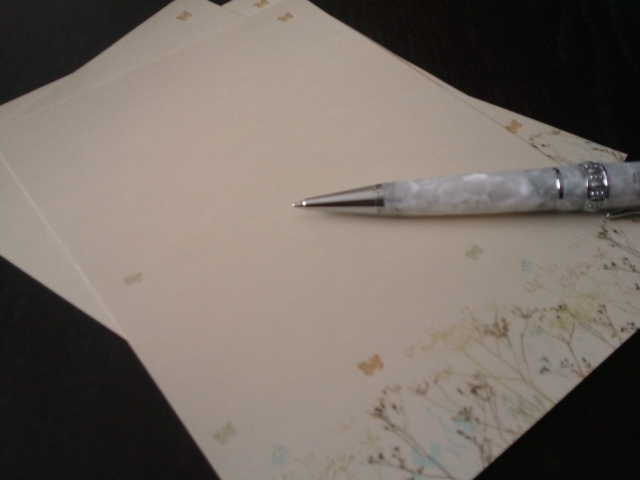
My new stationery and trusty pen, waiting patiently for me.

If you’re wondering who the lucky recipient is (and I know you’re on the edge of your seat), I’m writing to my grandmother. The truth is, I probably wouldn’t write this letter if she had ever learned how to use email. But, despite my attempts to convince her to try it, it’s become clear that’s not going to happen. And because I’m not too crazy about telephone conversations, I decided mailing a note would be a good way to stay in touch between family gatherings.

I know I’m not the only who’s been thinking about letter-writing. Earlier this week, I heard people will gather this Sunday at Toronto’s First Post Office to write letters. This reminded me of something I read in the Toronto Star about the Post a Letter Social Activity Club. The club consists of a group of people who meet regularly to write letters and notes.

The fascination doesn’t seem to stop with writing letters, or even with receiving them. We also like to read ones addressed to people other than ourselves. Entire books of letters have been published. On Valentine’s Day, I read about the letters of Elizabeth Barrett and Robert Browning going online. Instead of just reading transcriptions, the handwritten words can be viewed as Barrett or Browning would have seen them.

Maybe this interest in letter-writing is simply a matter of nostalgia. Or perhaps it shows that some forms of communication are forever relevant. In any case, I’m going to write this letter. I’m not sure yet what it will say, but I don’t think I’ll have a problem filling at least a few pages. This is why writing to your grandmother is a good choice—she’ll care to read every last word, no matter how much of it is drivel. I just hope she isn’t too critical of my penmanship.

Year In, Year Out

The Little Book of Clichés by Alison Westwood

My brother got me this neat book of clichés for Christmas. As I flipped through it the other day, I thought about some more clichés. And then I was inspired to write a poem about the New Year. 

Year In, Year Out

2011 has almost come to a close,
And I say good riddance!
The year was satisfactory, but nothing to write home about.
There’s no use crying over spilt milk;
Out with the old and in with the new.

Put your best foot forward in 2012,
And don’t sweat the little things.
Most people aren’t happy unless they are complaining,
But I say, If you can’t stand the heat, get out of the kitchen.
And always look on the bright side.

What will the new year bring? I’m champing at the bit.
But I suppose I’ll have to play it by ear.
Even though a picture is worth a thousand words, and actions speak louder than words, I’d still like to become a better writer.
You heard it straight from the horse’s mouth.

I’m wearing my heart on my sleeve.
I hope I haven’t bit off more than I can chew—I don’t want to eat humble pie later on. (That’s really not my cup of tea.)
You can’t teach an old dog new tricks, but perhaps he can get better at the old ones.
I’ve got my fingers crossed.

Three writing tips (for after you’ve finished writing)

So you’ve finished writing, and maybe you’ve even read your piece once or twice. But before you post/send/submit it, there are a few other things you should do.

Put it aside  

Hopefully you’ll read the piece a few times before you deem it finished. But when it comes to that final read, looking at it with fresh eyes is best. Fast-approaching deadlines can make it difficult to wait a day or even a few hours. But, at the very least, step away from the computer for a couple of minutes and do something else. When you return, you’ll be more likely to see what you actually wrote, not what you meant to write. If it’s possible, get someone else to read it, too.

Read it out loud

It’s easy to skip over problems when you read silently. Your eyes can trick you into thinking you wrote quite when you actually typed quiet. Reading out loud lets your ears catch these kinds of errors. Other benefits: hearing the words will point out run-on sentences and makes overused words and phrases hard to ignore.

Be meticulous

Attention to detail is key. Check everything, including facts, spelling, punctuation and word choices. Remember, even the most common words are often used incorrectly (know when it should be every day or everyday, or if you mean it’s or its). Confirm you’ve been consistent with style (did you use a serial comma in one place, but not in another?). And while you’re checking everything, don’t forget the main idea. Make sure you didn’t miss any points you wanted to address, and that you’ve followed through with what you set out to do.

What else? Feel free to comment with any other tips you have.


Write first, edit later

If you want to write, just write. Heard this before? It sounds easy, but it can be difficult to get your thoughts down without editing along the way. But writing is a process. Getting the ideas out is the first step; fixing the details should come much later.

November is National Novel Writing Month (NaNoWriMo), which means participants attempt to write 50,000 words of a novel in thirty days. The time period encourages writers to put words—any words—on paper (or screen). It doesn’t have to be the most beautiful prose ever written—the work can be polished later on.

Freewriting can help get these words out. Recently I took a writing course with author Brian Francis. At the beginning of each class, Brian had us write for about fifteen minutes. We weren’t to think too much about what we were producing, and we weren’t to go back and redirect our writing.

I found it a bit difficult at first. My natural inclination is to edit as I write. When I write at home, it’s usually on a computer, and I hit Delete multiple times as I go. It’s so convenient; I do everything from fixing typos to choosing better words to changing the direction entirely. But the problem is it ruins the flow, and it can throw a great idea off track.

I didn’t bring my laptop to Brian’s class. I had a good old-fashioned notebook. I put pen to paper at home, too, but mostly to jot down notes and passing thoughts, not to form full paragraphs.

With paper, it’s not as easy to edit while writing. I did go back to strike out things during these freewriting periods, but it wasn’t as convenient. And when I did cross out something, I could still see what I originally wrote when I read it over. Sometimes I liked my initial work better. It made me wonder how many good ideas I’ve lost to the delete key. I’ll never know.

But I’ll continue to write on my laptop. It’s faster than cursive writing, it doesn’t make my hand cramp up and it’s a lot easier for me to read (my penmanship isn’t fantastic). I just need to write on screen the way I can write on paper: free those ideas, then shape them. Write first, edit later.

Five Seinfeld moments and what they say about communications

Seinfeld was—and still is—one of my favourite television shows. The show “about nothing” often commented on how people communicate. Here are a few Seinfeld moments and what they say about communications.

1. “Yada, yada, yada”

Lesson: Be clear and explicit when you speak. Don’t gloss over details of the story, expecting your audience to know what you mean. If you rely on the other party to figure it out, you’re allowing them to fill in the gaps with their own details.

2. The puffy shirt

Lesson: If you don’t understand something, say so. Many of us will simply nod if we don’t hear or understand what someone is saying. It’s as though we feel it’s impolite to ask the person to speak up or to repeat what they’ve said. But it’s not impolite. And by thoughtlessly nodding, we can set ourselves up for great misunderstandings. So if you don’t understand, don’t nod.

3. The Moops 

Lesson: Remember to pay attention to detail. We all make the occasional typo, but some of these mistakes are worse than others. If you don’t proofread carefully, you could release incorrect information to the rest of the world.

4. The exclamation point

Lesson: Exclamation points are usually not a good idea. Most of the time, they aren’t necessary and overuse can annoy or distract readers. If you really feel an exclamation point is needed to denote excitement or anger in your writing, remember that one is always enough (i.e., “Great!” not “Great!!!!!”).

5. The counter

Lesson: Make eye contact when you’re conversing with someone. Eye contact is important because we get visual cues from each other when we are talking. We can see if the person is interested, bored or if they even heard us correctly in the first place.

Now, I wonder what all those hours of watching Saved by the Bell taught me.