The Lexicographer’s Dilemma shows us English is a beautiful mess

What I read

The Lexicographer’s Dilemma by Jack Lynch

What it’s about

This book examines how the English-speaking world has arrived at an idea of what “correct” English looks like. Lynch demonstrates that we shouldn’t be so concerned about using English correctly but rather we should be concerned about using English appropriately. And what’s appropriate can change depending on circumstances.

As Lynch takes us through the history of modern English, he provides lots of fascinating information on key figures (Samuel Johnson, Noah Webster, Peter Mark Roget, to name a few). Central to the book is the question of whether dictionaries should be prescriptive or descriptive, and Lynch explains the different views some of these key figures had regarding this.

How I got my hands on it

This Christmas I received some nice books and bookish gifts. This book was one of those gifts, and it was tucked neatly into my stocking. I can’t say for sure who it put it there, but I have a strong suspicion (Santa, of course).

A bit that I really liked

As much as I enjoyed reading about Johnson and the story of how this unlikely character created one of the most famous English dictionaries—I mean, I visited the house in London where he worked on A Dictionary of the English Language, so I’m a bit of a fan—the section on John Dryden stands out just a bit more for me. I’ve finally figured out who I can blame for this nonsense about not ending a sentence with a preposition and this BS about it being wrong to split an infinitive! Dryden was trying to make English follow the rules of Latin, but English isn’t Latin, guys.

Bonus bit: I got a real kick out of Lynch talking about people having issues with abbreviations in texts or social media. Don’t like it when people use “IMHO” or “obvs”? Well, then surely you must never say “AKA” or “fridge” or “exam” or “phone,” right? Thank you, Mr. Lynch, for pointing out this hypocrisy. It made me smile.

You’ll want to read it if…

You’ll probably like this book if you are any kind of word nerd. Proofreaders, editors, writers, people who read the dictionary for fun—you will love this book. But if you’re looking for a book that’s going to back up your rigid views on how the English language should work, you might not enjoy reading this. It will probably show you how silly you are being. I mean, I think it would be good for you to read it, but you might not want to.

Recommended refreshments

Any reading session is more enjoyable with snacks and drinks. For The Lexicographer’s Dilemma, I recommend consuming copious amounts of tea, and not just because tea and books always go well together. Rather, I suggest you drink this tea in honour of Samuel Johnson, as he was known to consume several cups a day. Imagine how many pots he must have gone through working on that dictionary! So, yes, tea is appropriate. And also maybe a bowl of alphabet soup?
 

Back to blogging

I haven’t posted anything here in over a year. My last post was published on New Year’s Eve 2014. I wasn’t sure then if I wanted to keep this space alive anymore, and I was more focused on the writing I was doing offline. So, basically, I never made a decision, and this blog has just been sitting here.

But now I’m back. Expect to see some posts about books I’m reading, which I haven’t done very much of in the past. I won’t be writing formal book reviews, but they will be reviews done my way. You’ll see what I mean. I might report on the occasional reading or literary event I attend, too. And I can’t say for sure that there won’t be an odd rant on something that’s bothering me (please don’t get me started on the serial comma debate again).

It’s a new year, and maybe this isn’t a new blog, but there’s a bit of a new direction. I’m looking forward to it.


Five of Toronto’s best literary events in 2014

This post is specifically about Toronto events, but if you’d like to read about the literary aspects of my trip to England earlier this year, visit my posts Lured back to London and Following the path of a poet.

Toronto hosts a lot of literary events. I don’t attend them all, of course, but I do get out to a few. In no particular order, here are five of my favourite literary events that I attended in 2014 in this city.

The Poem/The Song

To me, nothing goes better with a fall evening than listening to poetry being recited. This harkens back to my university days, when I spent some of my evenings inside classrooms studying poetry. One of the friends I attended many of those classes with invited me to The Poem/The Song held in Harbourfront Centre Theatre back in November. I don’t think I would have heard about it if she hadn’t mentioned it, as I hadn’t seen or read anything about it before or after. But I’m so glad we went. It wasn’t solely a literary event. As the title suggests, the evening largely focused on music. The Art of Time Ensemble performed musical works that are inspired by poems or poetry. There were pieces inspired by T. S. Eliot, Leonard Cohen, Walt Whitman and Petrarch. Margaret Atwood was also there to recite some of her own work. It was a unique way to honour two of my favourite art forms.

45 Books in 45 Minutes at Ben McNally Books

Ben McNally and Lynn Thomson host this event twice a year in their store in the financial district. The first for 2014 was held in the summer, and the second was in December, a few weeks before Christmas. During these evenings, Ben and Lynn provide a brief overview of 45 books that are new for the season (they also provide some delicious refreshments). They discuss some titles that are getting a lot of buzz, but one of the best reasons to go is that Ben and Lynn also discuss books you wouldn’t hear about it unless they told you about them. What’s better than partaking in some wine and cheese and hearing your favourite booksellers talk about books?

Tom Rachman reading at IFOA Weekly

This year, I went to many of the readings that were part of IFOA’s Weekly Series at Harbourfront Centre. But I’ve specifically included Tom Rachman in this list because of all of the readings I went to, his stands out the most in my mind. That’s partly because I was in the middle of reading Rachman’s latest book, The Rise and Fall of Great Powers, which he’d be reading from that June evening. Rachman began by talking a bit about his process of writing the book, discussing the various drafts he went through until he finally got the story right. He also inserted a sense of humour into his reading. When he signed my book afterwards, we had a short conversation about our affinity for independent bookstores…and also about the never-ending construction in this city.

It was raining that night. I remember the rain because it had started to fall so heavily by the time I left, that even though I had a bag to put my book in and an umbrella to hold above me, I had to tuck the book under my arm, and hug it close to my body, in an effort to protect it. (The book remained dry, but 85-90% of my body did not.)

Open Book Toronto literary salon: Advice for Myself

On a freezing cold February evening, I headed over to the Spoke Club for Open Book Toronto‘s literary salon, Advice for Myself. A panel of three writers—Stacey May Fowles, Brian Francis and Michael Winter—offered advice for both emerging and established writers, and there was the opportunity to mingle before and after. Becky Toyne moderated the event, but in the spirit of a true literary salon, there was also interaction from the audience. It was interesting to hear the different approaches and opinions that Stacey, Brian and Michael have, and I left feeling encouraged about my writing and with a few ideas that helped me improve my work.

The Word on the Street

This might be the most obvious choice on this list. The Word on the Street book festival happens every year and in cities across Canada, not just Toronto. If you’re reading my blog, there’s a good chance you’ve heard of it or have attended yourself. But I couldn’t leave it out. The Word on the Street is like Christmas for me, and I don’t mean that in the sense that I come home with an armload of books (I’ve scaled it down over the years). But I get pretty excited in the anticipation in the weeks leading up to that last Sunday in September. Sure, there’s the chance to browse some great books, and maybe even score some deals. But there’s also the opportunity to learn more about some wonderful organizations. This year, I had some nice chats with people from PEN Canada and Literature for Life, among others. There was also some interesting programming offered in many of the tents, including the Humber School for WritersWordshop Marquee, which I spent some time in.

Those are just a few examples of some of the wonderful events I and other Toronto-area readers and writers enjoyed in 2014. Wherever you live (or wherever you visit), there will be more to experience in 2015. I, for one, am looking forward to it.

Remembering poet Mark Strand

Yesterday Mark Strand died, a poet whose work I greatly admire. I first came across Strand’s poetry in my first year of university, where we read and discussed one of his most popular poems, “Keeping Things Whole.”

A couple of years later, a classmate and I went to see Strand read. It was the first time this classmate and I had spent any time together off campus, but it certainly wasn’t the last. We became very close that year and remain good friends. In a way, that night at the reading was when we became friends, or at least it marked a shift in our friendship: We moved from being school friends to becoming all-the-time friends, if that’s a thing.

On our way home that night, we talked about how cool Strand had looked and sounded on that stage. There was no other word for it: He was a cool guy. He reminded us of Clint Eastwood, or of how we imagined Clint Eastwood would be if he were reciting poetry in a dimly lit theatre in downtown Toronto.

I spent some of this weekend remembering Strand by reading some of my favourite poems of his, and I wanted to share a few here. I was reminded of how cool Strand really was and of how brilliant and beautiful his poetry is.

“Lines for Winter”

“From the Long Sad Party”

“The Idea”

“Man and Camel”

“The End” (with audio)

A soft spot for the semicolon

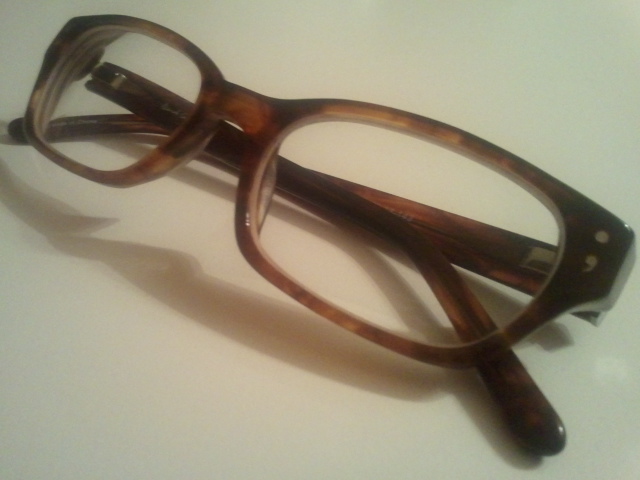
I bought a pair of glasses last week, and my new frames have punctuation marks on them. Specifically, there is a colon on one side and a semicolon on the other. SAMSUNG I have a bit of a soft spot for the semicolon. It’s misunderstood. A lot of writers are afraid to use it. Other writers do use it but use it incorrectly, often placing a semicolon where a comma should be instead. Even the name “semicolon” makes it sound as if it is a lesser point of punctuation than the colon.

Since semicolons aren’t the most commonly used punctuation mark, readers don’t see much of them. This creates a vicious cycle. I’ve heard that some publishers avoid the semicolon because the punctuation mark can be “distracting” to readers. I’m not sure I believe that, but even if it’s true, readers wouldn’t be distracted by the semicolon if they were more used to seeing it.

I love the semicolon for the sort of outsider persona I’ve imagined it having, but of course I also love it for what it actually does. The semicolon helps avoid confusion by separating listed items that contain commas. For example, “I’ll be going with Carl; Carl’s mother, Sheila; Jennifer; and Pat.” The semicolon tells the reader that Sheila is the name of Carl’s mother and not a separate person. The semicolon has been very helpful here—thank you, semicolon!—but this is not the only way to use this punctuation mark.

I like using a semicolon to connect two independent clauses; that’s my favourite way to use it. In the previous sentence, the two clauses would work fine as two sentences, separated by a period. But the semicolon ties them together so neatly. It offers a pause that’s just long enough—not too long, but not too short—that illustrates the link between the two statements. (Want more information about how to use the semicolon? Check out this post.)

A text can’t be read properly by concentrating only on the words. Just as music notation helps a musician understand how to play the notes, punctuation tells the reader how to read the words. So even though the semicolon might be my favourite punctuation mark, I love them all; they’re all equally important. But I’m happy to help give the semicolon a little more exposure.