The beauty of Wild Dogs

What I read

Wild Dogs by Helen Humphreys

What it’s about

A group of strangers have something in common: Their dogs have left their domestic lives and now roam in the wild as a pack. The group gathers near the forest each evening to call out to their dogs, hoping they will come back home. When a tragedy occurs, the group is forced to question the meaning of their relationships with each other.

How I got my hands on it

I got a copy of Wild Dogs through the Toronto Public Library. I was looking for something to read with no particular title in mind, and I decided to see which of Helen Humphreys’ books were available. I’ve read a few other books by Humphreys, and I like her poetic and meditative style of writing.

I wasn’t sure about Wild Dogs when I first saw it. It sounded so different from a lot of Humphreys’ other books, which are often historical fiction set in England. But I’d read the other titles the branch had available and thought I’d give Wild Dogs a try. Turns out, this is my favourite Humphreys’ book I’ve read (and has increased my desire to continue to read more of her work).

A bit that I really liked

The story is told in three parts: the first is Alice’s perspective, written in the second person; the second part is broken into several other perspectives, written in the third person; and the third part returns to Alice.

Alice’s sections were my favourites. Part of the reason might be because writing in the second person isn’t as common first or third, so it makes that writing stand out. Expressing Alice’s perspective in this way creates a more intimate connection with the reader. It’s like reading someone’s letters or their diary.

Since I got this book from the library, I know I’m going to purchase my own copy so that I can underline, highlight and make notes in the margins. This is one of the reasons that no matter how much I support libraries, I will never be able to stop buying books.

You’ll want to read it if…

You will probably like this book if you fall into any of these categories, but you will love it if all of these apply:

  • You like dogs.
  • You enjoy beautifully written prose.
  • You appreciate nature.
  • You like books that will have you thinking about them after you’ve stopped reading.
  • You’ve loved someone…and/or a dog.

Recommended refreshments

There are several places in this book where the characters imbibe, and understandably so. A bit of bourbon or scotch would go well with this novel. Just be sure to stop at a bit. This book will likely get you ruminating and reminiscing, and, well, too much of anything usually isn’t good.
How damn scary is The Damned?

What I read

The Damned by Andrew Pyper

What it’s about

To put it simply, The Damned is about a dead girl who haunts her twin brother. But that’s a little too simple, because there’s a lot more depth to this book.

The Damned explores the idea that twins have a special connection that isn’t really experienced in any other type of relationship. But it’s the angle that this relationship is explored that makes it different than other books about sibling relationships. The Damned looks at the destruction that this bond between twins can cause families and individuals.

The story is told from the first-person perspective of Danny Orchard. We get an inside look at Danny’s account of his relationship with his twin sister, Ash, both before and after her death. But, like Danny, the reader isn’t privy to the inner workings of Ash’s mind. We see what Danny sees. We know what he knows. We feel what he feels. And, like Danny, we are trying to figure Ash out.

How I got my hands on it

This was a book club pick. I’m not sure I would have read it otherwise. Pyper had been on my radar for a while, as I’d heard many good things about another one of his books, The Demonologist. But I was hesitant to give him a try because horror isn’t really a genre that appealed to me. I took this as an opportunity to try something out of my comfort zone and picked up a copy at the Toronto Public Library.

You’ll want to read it if…

I haven’t read any of Pyper’s other books, but judging from The Damned, he knows how to write a good horror story. Granted, I might be a bit of a wimp (I think my co-worker, who has read The Demonologist, thought I was joking when I said The Damned frightened me). And even for a wimp like me, it’s not like this book gave me nightmares or anything, but I did find it unsettling. It just gave me the heebie-jeebies.

There are supernatural elements in the book, after Ash has died and haunts Danny from “the After,” but those weren’t the bits that scared me the most. What was most frightening were the parts when Ash was still alive. That’s because it seemed so real, that what happened with this family could happen in any family.

It’s kind of a funny situation: Pyper is such a good writer that I don’t know if I want to read any of his other books—at least not any in the horror genre. But if horror is your thing, add The Damned to your reading list.

Recommended refreshments

Reading this before bed? Maybe make yourself a mug of warm milk or a hot toddy, just in case you need some help falling asleep.

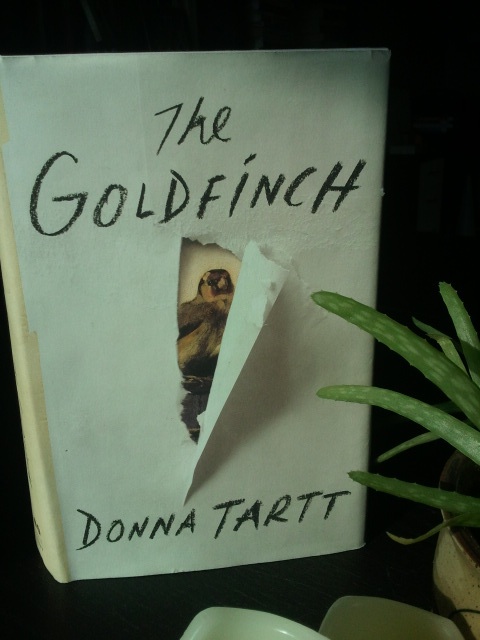
On The Goldfinch and the value of savouring books

Every now and then, I’ll hear about a book that’s getting a lot of buzz. I’ll decide to read that book, trying to keep my expectations low for fear that it won’t be what I’d hoped. But Donna Tartt’s The Goldfinch exceeded my expectations. It’s not just because Tartt created a great story or wrote beautiful prose. Rather, I liked the book so much because both of these elements were crafted so exquisitely.

The fast-moving plot kept me turning pages when I should have gone to bed. But the language caused me to pause, think and feel, to climb out of myself and into the world of protagonist Theo Decker. I can’t remember the last time a book so strongly made me both want to speed up to find out what happens and slow down to relish in the writing.

My only regret is that I reached the end of The Goldfinch while reading in bed one night, and I had to try to fall asleep when all I really could do (and all I wanted to do) was stay awake and think about the book.

SAMSUNG

It’s been almost a week since I finished reading The Goldfinch. I haven’t started another book yet—which is unusual for me—for no other reason than I am still steeped in it, not ready to let it go, returning several times to the last 20 pages or so to reread and resubmerge myself in it.

It’s when you have a reading experience like I did with The Goldfinch that you realize how powerful literature can be. The characters are seen so clearly. You can feel their presence beside you. You’re not being told someone’s story; you’re there living it with them.

I know many readers have pledged to read 50 books this year, but it’s just not something I can get behind. Maybe I’ll read less than 50; maybe I’ll read more. But I don’t see how the amount of books read should be more important than the experiences we have with them. If your focus is on the quantity of books, or on the speed of getting through them, you risk missing something that might hit you in a way you hadn’t imagined if only you gave it the chance.

It can be tempting to read as much as possible. There are so many books and so little time. But try to take a step back when you’re in the midst of the book. Savour the pages. And try to take a moment to let it all sink in when you’ve finished. Some of the greatest moments that come from a book can occur after you’ve turned the last page.

Write first, edit later

If you want to write, just write. Heard this before? It sounds easy, but it can be difficult to get your thoughts down without editing along the way. But writing is a process. Getting the ideas out is the first step; fixing the details should come much later.

November is National Novel Writing Month (NaNoWriMo), which means participants attempt to write 50,000 words of a novel in thirty days. The time period encourages writers to put words—any words—on paper (or screen). It doesn’t have to be the most beautiful prose ever written—the work can be polished later on.

Freewriting can help get these words out. Recently I took a writing course with author Brian Francis. At the beginning of each class, Brian had us write for about fifteen minutes. We weren’t to think too much about what we were producing, and we weren’t to go back and redirect our writing.

I found it a bit difficult at first. My natural inclination is to edit as I write. When I write at home, it’s usually on a computer, and I hit Delete multiple times as I go. It’s so convenient; I do everything from fixing typos to choosing better words to changing the direction entirely. But the problem is it ruins the flow, and it can throw a great idea off track.

I didn’t bring my laptop to Brian’s class. I had a good old-fashioned notebook. I put pen to paper at home, too, but mostly to jot down notes and passing thoughts, not to form full paragraphs.

With paper, it’s not as easy to edit while writing. I did go back to strike out things during these freewriting periods, but it wasn’t as convenient. And when I did cross out something, I could still see what I originally wrote when I read it over. Sometimes I liked my initial work better. It made me wonder how many good ideas I’ve lost to the delete key. I’ll never know.

But I’ll continue to write on my laptop. It’s faster than cursive writing, it doesn’t make my hand cramp up and it’s a lot easier for me to read (my penmanship isn’t fantastic). I just need to write on screen the way I can write on paper: free those ideas, then shape them. Write first, edit later.

Revisiting the joy of Joyce, one tweet at a time

Even though I studied English in university, I haven’t read Ulysses by James Joyce. I meant to, but it wasn’t in the curriculum, so it’s remained on my “to read” list ever since.

There’s good news for those of us who have yet to read this classic. On June 16, if you can find time to get on Twitter, you’ll have time to read Ulysses.

OK, it won’t be exactly the way Joyce wrote it. Volunteers from all over the world will narrow down sections of the book to a series of tweets to celebrate Bloomsday.

This will be an interesting experiment to see what social media can do for classic literature. I still want to read Ulysses in its entirety, the way Joyce intended. But this experiment has put this more in the forefront of my mind than it was, say, a month ago.

Maybe social media will increase the popularity of reading classic novels. Young people who have never heard of James Joyce will run out to the nearest bookstore or library to get their hands on a book. Maybe not. But they might download the ebook.

James Joyce