Books and bakes #2: Big Girl, Small Town and stromboli

The bake

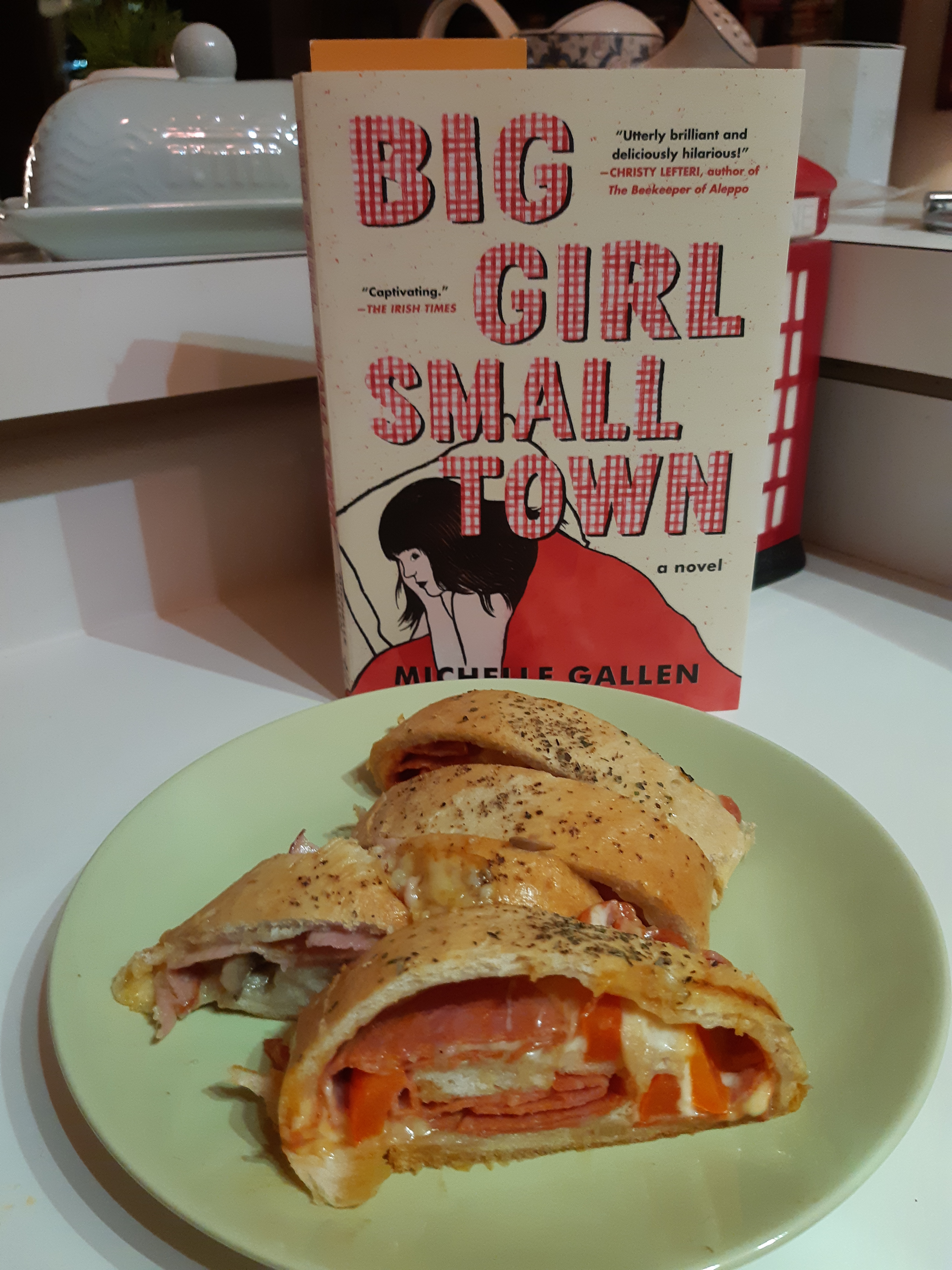
I don’t bake a lot of savoury things. Sweets are more in my wheelhouse. But this recipe for stromboli on Sally’s Baking Addiction interested me. So when my boyfriend suggested we bake something together, it seemed like a great time to try out this recipe. (Plus, it saved us from figuring out what to have for dinner.) Sally’s recipe calls for enough dough to make two stromboli, suggesting you use the dough to bake one and freeze the second to use another time. But we made both so that we could try different filling combinations. We made one with pepperoni, red pepper, Edam, and mozzarella. We filled the second with ham, mushrooms, cheddar, and mozzarella. If I had to pick a favourite, I’d choose the pepperoni, But they were both delicious! As Sally points out, it’s a combination of bread, cheese, and meat, so you can’t really go wrong.

The book

This weekend, I’ve been reading Big Girl, Small Town by Michelle Gallen. This novel is about a young woman who works in a fish-and-chips shop in a small town in Ireland. Majella lives with mother, who is an alcoholic and often needs Majella to look after her. Majella is also dealing with the recent murder of her grandmother, for which there has been no arrest. That all sounds much more grim than the book actually is. I’m only about 50 pages in. So far, Gallen has given a real sense of Majella’s quiet and mundane life, but I am hoping for more of the hilarity and entertainment that the book jacket copy and endorsements promise.

Books and bakes #1: The Discomfort of Evening and cinnamon rolls

It’s a grey Sunday here in Toronto, and, while it’s not too cold (for January), it’s one of those lazy days where I haven’t left the house. I knew I’d get some reading in today but wasn’t sure I felt up to baking. Then I realized it was a good time to bake something with yeast, since I could read while I waited for the dough to rise.

The bake

I’ve been thinking about baking cinnamon rolls for a while, and today was my first attempt. I used the Easy Cinnamon Rolls (from scratch) recipe from Sally’s Baking Addiction. These were, in fact, quite easy to make. But next time I think I need to make a better roll (like, make it tighter or something?). Anyway, I enjoyed one of these fresh from the oven with a bit of icing drizzled on top. I didn’t frost all of them, as I’m planning on freezing some of them. My guess is that, even if I warm up the others, they won’t be quite as good later on. But they’re still homemade cinnamon rolls, and that’s something to be excited about.

The book

I’m reading The Discomfort of Evening, written by Marieke Lucas Rijneveld and translated from the Dutch by Michele Hutchinson. The story follows Jas, a young girl, who lives on a farm in the Netherlands with her family. Her older brother, Matthies, dies tragically at the very beginning of the book, and Jas and her remaining siblings are left to contemplate death and watch their parents grieve. The novel is well written (it did win the 2020 International Booker Prize, after all), and I am interested in the characters and how they cope with Matthies’ death, but I am finding it a little heavy and somewhat disturbing for my current mood. Luckily, the cinnamon rolls are providing a bit of comfort to go with this discomfort.

The books I read in 2020

Back in March, when COVID-19 first infiltrated our lives here in Canada, there were a few weeks where my reading habits changed. I found it difficult to concentrate. When I could concentrate, I certainly didn’t want to read anything too dark or heavy. But it wasn’t very long until, for the most part, I got back to my regular reading habits. I’ve read almost as many books in 2020 as I did in 2019.

It’s been a strange year (what an understatement!). As 2020 comes to a close, there’s a lot I don’t want to think about–a lot of things I wish I didn’t have to think about. It’s nice to take a break to reflect on the things I do want to hold on to, including the books I’ve read during these past 12 months.

Stand-out books

The longest book I read

Americanah by Chimamanda Ngozi Adichie (588 pages)

The shortest book I read

Ethan Frome by Edith Wharton (99 pages)

The book I didn’t expect to like but ended up loving

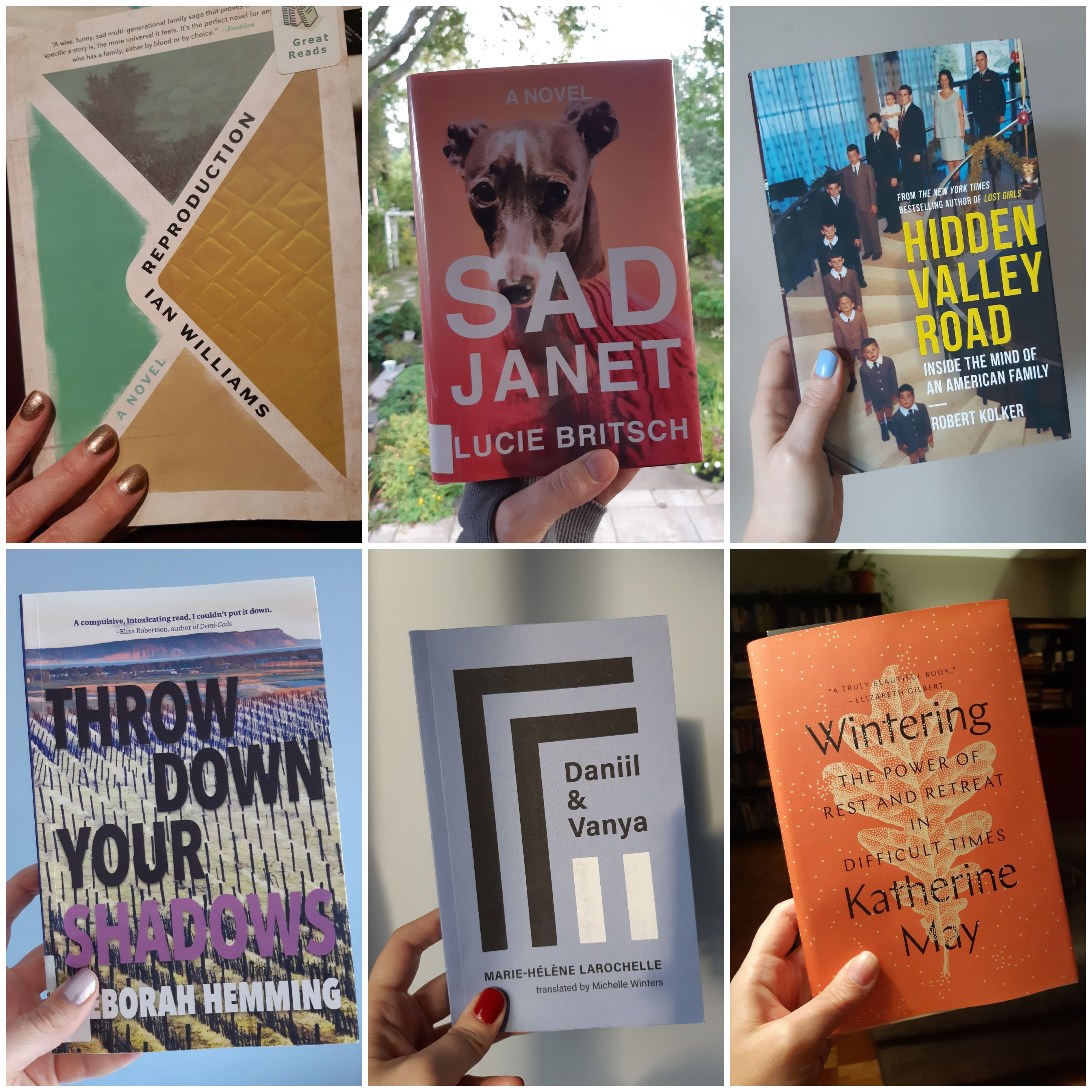
Reproduction by Ian Williams. I probably wouldn’t have read Reproduction if it weren’t for the Giller Prize. And that’s not because the novel won the 2019 prize, either. During the award ceremony, before the winner was announced, I tuned in to the broadcast and heard Williams describe his book. I was sold. Prior to that, I didn’t know much about the novel. I had picked it up at the bookstore once and flipped through it, noticed that it was a bit experimental, and decided I wasn’t feeling that. I’m glad I was swayed to read this because I loved this story of an unconventional family in the Greater Toronto Area in the 1990s. And the experimental structure turned out to be a delight!

The book I expected to love but didn’t

The Perks of Being a Wallflower by Stephen Chbosky. It’s no secret that I’m partial to a good coming-of-age tale. This one is a classic–one I’ve heard about for many years and that has been adapted into film. This might be a case of me expecting too much from a book, but there are many novels in this genre that have spoken to me more than this one did. I didn’t hate this book, but it was a bit forgettable.

The book that is perfect for everyone to read right now

Wintering: The Power of Rest and Retreat in Difficult Times by Katherine May. I read about Wintering somewhere online (of course I don’t remember where) and promptly added it to my to-read list on Goodreads. I do this with a lot of titles, and many remain on the list for some time (or never leave it). However, it was only the next day or so after I added Wintering that I was in the bookstore and, not looking for this book, happened upon a copy on a table. I was compelled to buy it. Wintering is partly a memoir and partly a meditation on the times in life when things are just, well, bad. Instead of fighting against our difficulties, why not try to accept them and comfort ourselves instead? In this beautifully written book, May looks at her own experiences and also shares examples from nature about resting and retreating during dark times.

The book that made me LOL

Eleanor Oliphant Is Completely Fine by Gail Honeyman. This book has been out for a couple of years, but it previously hadn’t interested me enough to pick it up. But then, when the pandemic hit, I was looking for something lighter to read, something that might make me laugh. And Eleanor Oliphant Is Completely Fine delivered. This novel about a socially awkward woman learning how to open up and deal with her dark past is very funny and uplifting without being corny or overly sentimental. It was just what I needed.

The book that had been sitting on my bookcase unread for too long

Fingersmith by Sarah Waters. I can’t believe I hadn’t read this novel until this year. I bought it a few years ago, after The Paying Guests came out (the first Waters book I’ve ever read.) After reading that one, which I adored, I kept hearing Fingersmith was Waters’ real masterpiece. I picked it up at the bookstore and then just never got to it. I even read The Little Stranger in the meantime, which remains one of my favourite books ever. And yet Fingersmith sat and waited for me. And then this year, when the libraries were still closed and the bookstores weren’t open for browsing, I finally picked it up. Fingersmith is an engrossing twisty novel about petty thieves in Victorian England, and I enjoyed it immensely (but not as much as I enjoyed The Little Stranger).

The books that had me saying “Just one more chapter”

  • Daniil and Vanya by Marie-Helene Larochelle, translated by Michelle Winters: A story about a couple who adopt twin baby boys, but the happy family they imagined doesn’t quite work out.
  • We Keep the Dead Close: A Murder at Harvard and a Half Century of Silence by Becky Cooper: A true story about the 1969 murder of a female Harvard anthropology student that remained unsolved for 40 years until Cooper first hears rumours about the murder as an undergrad. She then spends the next 10 years looking into what happened, trying to find justice for the victim.
  • Throw Down Your Shadows by Deborah Hemming: A coming-of-age story set in rural Nova Scotia about manipulation and the dark side of teenage relationships.
  • Here Is the Beehive by Sarah Crossan: A compelling novel about a lawyer who learns the client she has been having an extramarital affair with has tragically died. The story follows her as she befriends his widow as she tries to make sense of his death and of their relationship.

My 5 favourite books read in 2020

  • Hidden Valley Road: Inside the Mind of an American Family by Robert Kolker: An incredible and true story of mental illness and a thought-provoking exploration of family. My favourite book read this year.
  • Rabbit Foot Bill by Helen Humphreys: Based on a true story, this novel is about a boy in 1940s Saskatchewan who befriends the local tramp, Rabbit Foot Bill, and witnesses him commit a violent murder.
  • Sad Janet by Lucie Britsch: A hilarious novel about being sad and basically being okay with that, even if others aren’t. A real gem.
  • Reproduction by Ian Williams: A quirky, poetic novel about an unconventional family that combines serious subject matter with humour and an experimental structure.
  • The Girl with the Louding Voice by Abi Daré: An impressive debut novel about a Nigerian girl who, despite being sold into marriage by her father, is determined to get an education and have her voice heard.

By the numbers

Books bought: 56% (bought new: 53%, bought used: 3%)

Books borrowed from the library: 31%

Books received as gifts: 7%

Books borrowed from friends: 6%

Books written by Canadian writers: 22%

Books published in 2020: 46%

Fiction: 82%

Non-fiction: 18%

I felt like I had read more non-fiction than in past years, but, in actuality, the number has gone down a bit. Maybe it just feels like more because the non-fiction books that I did read were so damn good. Without being able to browse in bookstores for much of the year, and with the libraries being closed for a few months, I cracked open some of the books that had been on my shelves for months or even years. That being said, almost half of what I read this year was published in 2020 (I do like my contemporary titles).

I finally accepted that it’s okay to not finish a book. I mean, I’ve not finished books in the past, but it’s never been a regular practice for me. Usually, if I am not enjoying a book, I stick with it, hoping something will pull me in. But, in 2020, I put aside more unfinished books than ever before, and I feel good about that. Sometimes the book just isn’t for me, but sometimes it’s just not the right time for that particular title. I like to think of these books as not being “left unfinished,” but more as being “put aside for now.” Sometimes a book will serve us better at a different time in our lives. I like knowing I can return to them later on, when they might be just what I need.

As always (but perhaps this year more than ever before), I am grateful for books. I am thankful for the authors who write them, the publishers who get them out into the world, the journalists and bloggers who promote them, and the bookstores and libraries who get them into the hands of us readers. I don’t know what 2021 will bring, but I am betting that whatever comes our way, books will help us get through it.
The books I read in 2019

20191230_202211

The 2019 best-of book lists are out, and, if you’re like me, you’ve added a few (or many) titles to your to-read list. While I get excited thinking of all the books I want to read, I also like to reflect on what I’ve read in the past year (as I’ve done in 2018, 2017 and 2016). So I’m putting down my mug of tea and plate of shortbread cookies to break it down. Maybe you’ll find another book or few to add to your to-read list?

Stand-out books

The longest book I read

The Heart’s Invisible Furies by John Boyne (592 pages):

The shortest book I read

84, Charing Cross Road by Helene Hanff (97 pages)

The book I didn’t expect to like but ended up loving

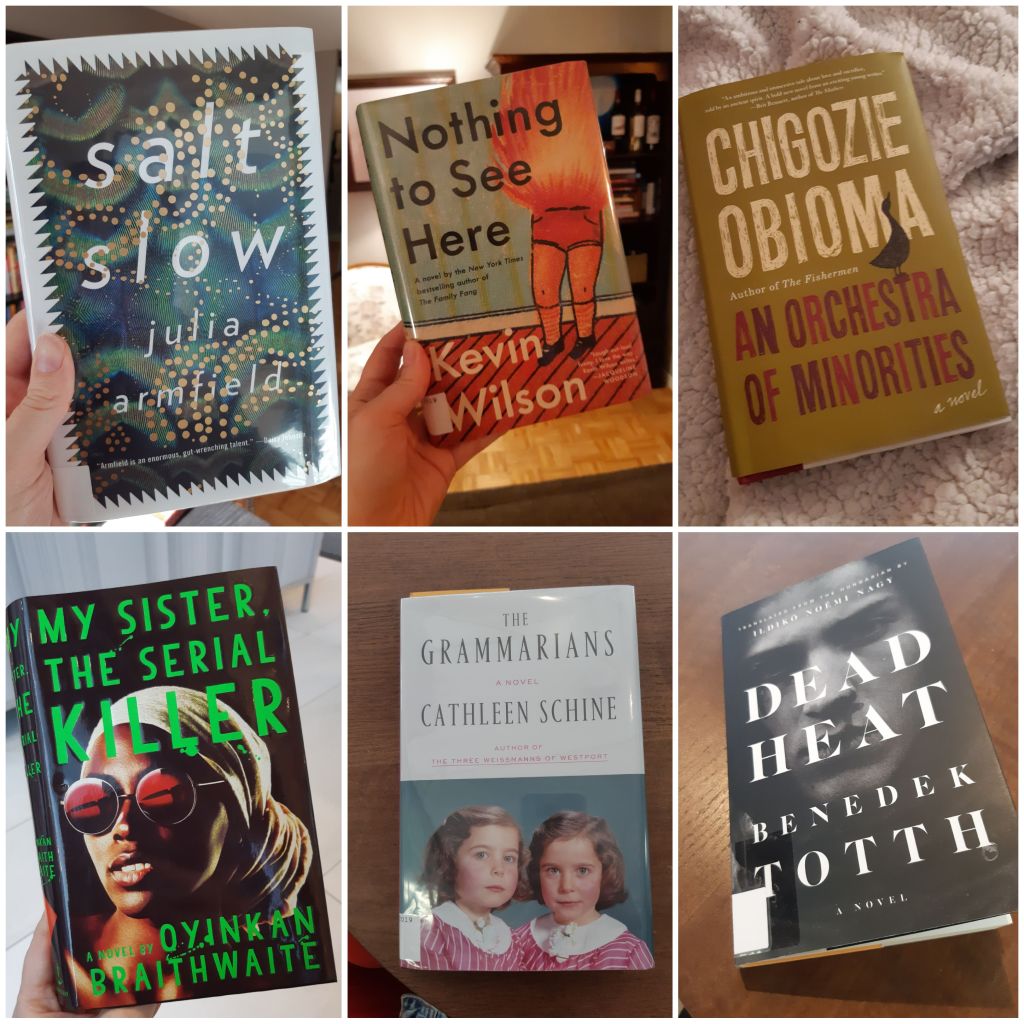
Salt Slow by Julia Armfield. I had heard good things, so I was intrigued, but I didn’t think this book sounded up my alley. I’ve often been dismissive of magic realism, and, while I’ve been really into linked short stories in the past few years, other short story collections haven’t appealed to me as much. But I loved this collection. Armfield does an amazing job of using fantastical elements to illustrate real and universal female experiences. I borrowed a copy from the library, but I may buy one, too (I already want to reread some of these stories).

The book I expected to love but didn’t

The Factory by Hiroko Oyamada. This is a case where formatting really affected my enjoyment of the writing. This book is filled with long paragraphs. I think the only places there were paragraph breaks were when there were time breaks. I found it especially difficult with dialogue, as I’d lose track of who was speaking or even if it was dialogue or narration. It’s too bad because the story was a wonderfully weird take on modern life–about three unrelated characters who work in different areas of a factory–but I had so much trouble following that I couldn’t really get into it.

The book that I loved to hate

Dead Heat by Benedek Totth. I was attracted to this book because I’d heard it compared to Trainspotting (which I am a big fan of) and because I love coming-of-age stories (this one about a group of teenagers on a swim team in Hungary). But I didn’t expect it to be quite so raw and violent and gritty. I didn’t expect so much of the book to make me feel physically ill or for it to make me angry in so many places. I’m impressed by any writer who can evoke those kinds of feelings in a reader. It certainly is well-written. I can’t call this book “enjoyable,” but reading it was quite an experience.

The book I knew I wanted to read from the title alone

The Grammarians by Cathleen Schine. I read my share of non-fiction books about language, as many word nerds do. But a work of fiction called The Grammarians? This novel had my heart before I knew the premise. I fell in love with this one because of its playfulness with language and its humour. But I liked it even more because Schine tied these aspects with a more poignant story of two sisters who are inseparable and how they come apart.

The book that taught me a lesson I didn’t know I needed

Semicolon: The Past, Present, and Future of a Misunderstood Mark by Cecelia Watson. I’ve thought about privilege in many ways in the past few years. What I hadn’t given much thought to was my privilege as a native English speaker as someone who lives in Canada. This book made me think about that a lot. And it has me thinking about how I can use my passion for language in ways that are more beneficial to others.

The book I wouldn’t have read if I hadn’t taken part in the Toronto Public Library’s reading challenge

Was She Pretty? by Leanne Shapton. To be honest, there were several books I wouldn’t have read this year if I hadn’t participated in the library’s reading challenge. But some of these were books that had been on my to-read list for years, or ones that I could see myself stumbling across eventually. But I’m pretty sure I wouldn’t have picked up this one in any other circumstance. I read the library’s blog post about non-prose books and saw this one as a suggestion. The book consists of mostly drawings with minimal text, and explores jealousy in relationships.

The books that had me saying “Just one more chapter”

  • The Body in Question by Jill Ciment: The story centres on two sequestered jurors on a murder trial who have an affair…but there’s so much more going on in this one, too.
  • The Silent Patient by Alex Michaelides: An excellent psychological, twisty and unputdownable thriller about a woman who kills her husband, then refuses to talk, and the therapist who is determined to get her to speak.
  • Educated by Tara Westover: An incredible memoir that tells the story of a woman who is born into a family of survivalists.

My 5 favourite books read in 2019

  • An Orchestra of Minorities by Chigozie Obioma: A heartbreaking story about a Nigerian poultry farmer who will do anything to be with the woman he loves.
  • My Sister, the Serial Killer by Oyinkan Braithwaite: A fun and dark thriller (love this combo!) about a woman who is constantly having to clean up her sister’s messes–the murders of her sister’s boyfriends.
  • How to Behave in a Crowd by Camille Bordas: A story about adolescence, sibling relationships and tragedy. This book was sweet, sad and very funny, too. I adored the narration of protagonist Isidore Mazal–the youngest of six siblings–who is 11 years old when the book opens and 13 when it ends.
  • Nothing to See Here by Kevin Wilson: A woman begins looking after her former roommate’s stepchildren: twins who have the ability to spontaneously combust. It’s so weird and funny and touching all at the same time.
  • Salt Slow by Julia Armfield: A collection of short stories that blend realistic depictions of female experiences with beautiful fantastical elements.

By the numbers

Books bought: 47% (bought new: 44%, bought used: 3%)

Books borrowed from the library: 39%

Books received as gifts: 7%

Books borrowed from friends: 7%

Books written by Canadian writers: 27%

Books written by women: 70%

Books published in 2019: 49%

Fiction: 78%

Non-fiction: 22%

So it looks like I did increase my non-fiction books and have read some genres and writing styles I have avoided in the past. For one thing, I think I have to stop saying I’m not into magic realism. Not sure when it happened, but I think I actually really am into it…like, maybe even a lot?

I said I wanted to read bigger books in 2019…but that didn’t really happen. I’d like to take that goal into 2020. But, even more, I’d like to not put too much pressure on myself. I’m continuing to grow as a reader, and that’s good enough for me.

On the desire to be better at gifting books

20190512_144951

books on display at The Paper Hound in Vancouver, BC

Surprise, surprise: I love books. I love buying books, browsing books, borrowing books, looking at books, learning about books and, of course, reading books. But, as much as I love gifting books, I’ve been doubting how good I am at it.

I’ve written about why books make the best gifts, and I truly enjoy going into bookstores, thinking about the recipient and choosing something I think they will like based on their interests/life/other books they’ve read and liked. But, as much as I like doing this, I don’t know if I’ve really done a good job of getting it right.

When I think about it some more, it’s not even just gifting books. It’s also giving book recommendations, or lending books to people when they ask for “whatever you think I’ll like.” I like it when people do that, but how many times have people come back and said they loved the book? (Well, it’s happened for sure. I don’t always get it wrong. But I guess I’m saying I wish it happened more.) Thankfully, booksellers and librarians are there to help.

Maybe I’m putting too much pressure on myself. After all, I don’t always love the books people give or recommend to me, but I do always, always appreciate it when I can see the thought that was put into that selection, when I can see how the person had my interests/life/books I’ve read and liked in mind.

I’ll continue giving books to people (sorry if you’re a person in my life who hasn’t liked what I’ve picked out for you in the past). I can’t help it; I love sharing the book love way too much to stop now.

Are you good at gifting books or offering personalized recommendations? What do you think about when deciding which book to gift or lend someone?